Kathmandu, Oct 2: More than 800 important Nepali historical documents from the 13th to the 20th century, which were in the private collection of a German citizen, Joseph Peter Rindfleisch, have been handed over to the National Archives of Nepal.
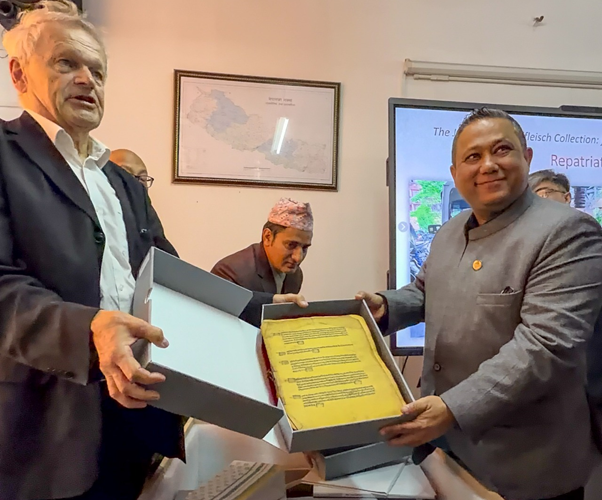
At a programme held today at the National Archives, the historical documents were jointly handed over to Foreign Minister Shisir Khanal by Professor Axel Michaels of Heidelberg University’s Heidelberg Academy of Sciences and Humanities, Dr. Manik Bajracharya, and Rajan Khetwadi.
Professor Michaels is a friend of Walter Rindfleisch, Joseph Rindfleisch’s son. Walter had handed over his father’s documents to Professor Michaels to return them to Nepal.
After that, Professor Michaels handed the documents over to Nepal through Heidelberg University.
Those historic documents were handed over to the National Archives in the presence of Foreign Minister Shishir Khanal.
The documents were brought back to Nepal through the collaboration of the Nepali Embassy in Germany, the Heidelberg University, Heidelberg Academy of Sciences and Humanities, Saraf Foundation, and the National Archives.
Foreign Minister Khanal said that the return of the historic document to the country has restored Nepal’s cultural integrity and sovereign ownership over its civilizational heritage.
“Our arts, literature, traditions, and sacred texts are not just physical artefacts; they are the living soul of our civilization. They carry centuries of philosophical thought, political governance, legal knowledge, and spiritual life. The return of every historical document to its original land is a restoration of cultural rights and a reaffirmation of our sovereign ownership over our civilizational heritage,” Foreign Minister Khanal said on the occasion.
Minister Khanal recalled that the late Joseph Peter Rindfleisch had expressed a desire to return more than 800 important Nepali documents from his private collection to the country and appreciated his respect for cultural heritage and visionary thinking.
He expressed gratitude that Walter Rindfleisch, the son of Rindfleisch, honored his father’s wishes by handing over those documents to Dr. Axel Michaels, a professor at the South Asia Institute of Heidelberg University.
“This extraordinary archive contains ancient palm-leaf manuscripts, royal decrees, court orders, Sanskrit texts, and accounts of historical journeys. These documents are an indispensable source for understanding Nepal’s political, legal, and intellectual development,” he said.
Minister Khanal praised Professor Dr. Axel Michaels and his research team for contributing to the identification, archiving, and repatriation of documents, saying that their academic integrity, research, and continuous efforts made the return of historical documents possible.
This collection, gathered from Nepal during the 1780s and 1990s, includes over eight hundred official documents such as ‘tadpatra’ or palm-leaf manuscripts, ‘rukka’, and ‘lalmohars’. The collection was preserved and catalogued by the Heidelberg University Library and the Heidelberg Academy of Sciences and Humanities, and returned to Nepal in collaboration with the Nepalese government. Some of the palm-leaf manuscripts in this collection are among Nepal’s oldest documents.
According to the collection list, there are 465 palm-leaf manuscripts from the Malla period with lalmohars, 312 legal documents and state papers from the Shah and Rana periods with clay seals, 18 handwritten books and travel diaries from the Rana Prime Minister’s office, and 11 handwritten books on various subjects.
He mentioned that Nepal and Germany are parties to the 1970 UNESCO Convention on the Means of Prohibiting and Preventing the Illicit Import, Export and Transfer of Ownership of Cultural Property, and said that the handing over of the documents highlighted their shared commitment to the spirit and essence of the international convention.
“Today’s handover is an important example of our shared international commitment. We greatly appreciate the active support provided by the German government, the German Embassy in Kathmandu, and Heidelberg University for the smooth return of these documents,” he said.
Minister Khanal recalled that on April 24, 2026, Professor Dr. Michaels formally handed over those documents to the Nepali Embassy in Berlin. He also appreciated the coordination between the Nepali Embassy, the Ministry of Foreign Affairs, and the National Archives in this process.