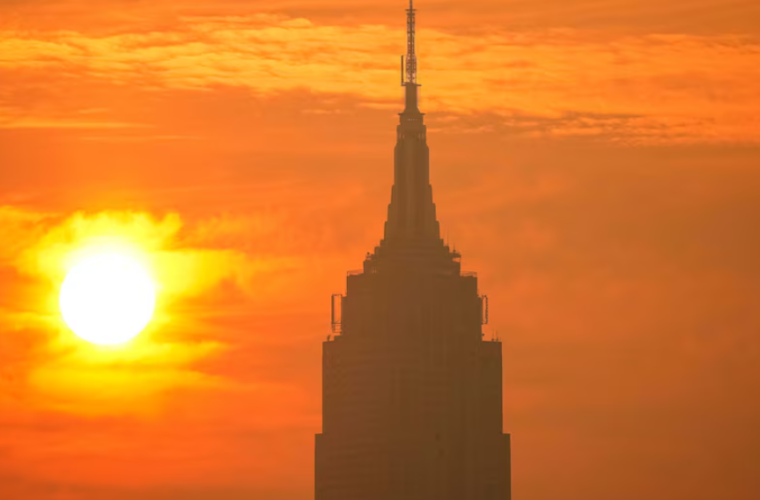
Reuters : Wildfire smoke blanketed the eastern U.S. from the Great Lakes to Washington, D.C. on Friday, floodwaters tore through Texas’s Hill Country for a third day, and new fires erupted in the Pacific Northwest overnight, with 68 large blazes now burning in 15 states.
Millions of Americans faced hazardous conditions and orders to stay indoors, as the country’s summer weather extremes converged on three fronts at once: a smoke-choked East, rising water in the South, and fast-spreading flames in the West.
Firefighters are now battling 68 large fires nationwide, up by nearly two dozen from a day earlier. Some 17 new blazes broke out in the Pacific Northwest after a run of lightning strikes made it the most active fire region in the country, according to a summary from the National Interagency Fire Center.
More than 17,400 personnel, 140 helicopters and four military C-130 air tanker crews are now deployed across the U.S. to battle wildfires, with record-low snowpack in the Mountain West and drought pushing fuel conditions to the type of dry and fire-prone levels normally not seen until mid-August, according to the NIFC.
Nearly 3.72 million acres (1.51 million hectares) have burned nationwide so far this year, outpacing last year’s mid-July tally by over 1 million acres.
Jesse Berman, a professor at the University of Minnesota School of Public Health whose research focuses on how extreme weather affects health, said simultaneous disasters like those playing out now can make them more dangerous.
“These are compound events, and that can sometimes make the impacts of them far worse than what we would experience with any one of these events individually,” Berman said.
University of Pennsylvania climatologist Michael Mann said the extreme weather events were linked by a wave pattern in the jet stream that may be a phenomenon known as “resonance.” This occurs when large waves in the jet stream become amplified and trapped, causing extreme weather to persist over a region for longer periods, creating more chaos.
just taking extra precautions, but it’s also his birthday so we don’t want to limit our life and, you know, excitement to be in the city and go around, but it’s hard.
Mann said his research shows that human-driven climate change has led to a tripling of these stalled jet stream events since the 1950s.
Climate scientist Jonathan Overpeck, dean of the University of Michigan’s School for Environment and Sustainability, said rising temperatures are driving disasters through the same basic mechanism, even though the effects can look opposite.
A warmer atmosphere pulls moisture out of soil and vegetation more aggressively, which has left Canada’s landscape drier and more fire-prone. At the same time, a warmer atmosphere can hold more water vapor before releasing it, which is producing the kind of intense, heavy rainfall now battering Texas.
“What climate change is doing is it’s rolling the dice so that you’re going to get drier conditions and more wildfires at the same time as you’re going to get more rain,” said Overpeck.