Kathmandu, Oct 16: Nepal has much to learn from Xizang (Tibet), particularly in infrastructure development, cultural heritage preservation, tourism promotion, and public discipline, speakers said at a programme held in Kathmandu on Friday.
Organised by the Saino-Nepal Cultural and Tourism Promotion Society, the programme highlighted the centuries-old historical, cultural, and social ties between Nepal and Xizang. Speakers stressed the need for Nepal to learn from the region’s development experiences and explore opportunities for greater cooperation.
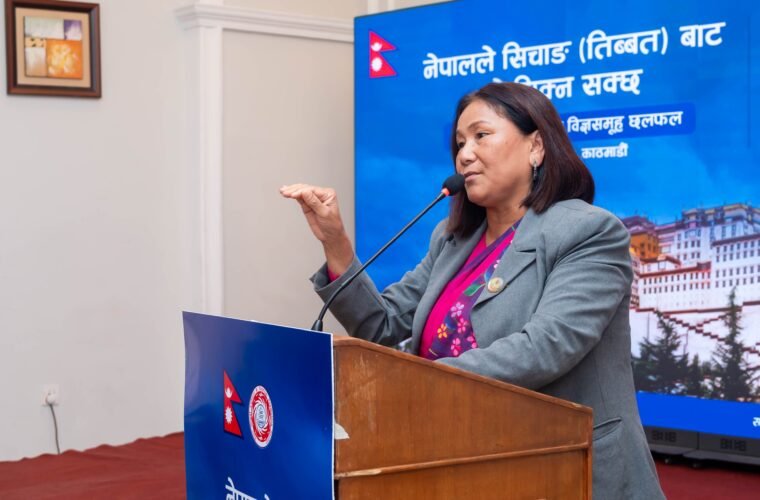
Former Deputy Speaker Indira Rana Magar said Nepal should learn from Xizang’s development achievements and use those lessons to accelerate its own progress.
She emphasised that national pride alone was not enough and that Nepal needed to take practical steps towards development. She also praised China’s efforts to turn cultural preservation into a source of employment and said Nepal should adopt similar approaches. Despite their geographical proximity, she said, Nepal had not fully benefited from the opportunities available in Xizang, urging the government to take the initiative.
Nepal’s Consul General in Lhasa, Laxmi Prasad Niraula, said his experience in Xizang had been different from what he had initially expected when he assumed office two years ago. He noted that Nepal and Xizang had maintained historical ties for more than 2,000 years.
Recalling Nepal’s historical trade links with Tibet, Niraula said Nepal had established an office there during the reign of Jung Bahadur Rana and sent officials to facilitate relations. Nepali traders had also transported goods to the region for commercial purposes.
He further noted that Tibetan currency had historically been minted in Nepal and that similarities between Tibetan culture and Nepal’s Newar heritage reflected the longstanding relationship between the two regions.
Niraula said Nepal should draw lessons from Xizang’s modern infrastructure, particularly its railway networks and tunnels.
“ Nepal should learn from the railway and tunnel infrastructure developed in Xizang and use those lessons to accelerate its own development. We should also learn from the discipline and time management there,” he said.
He pointed to the punctuality of official programmes and the efficiency of administrative procedures as examples Nepal could follow.
Niraula also stressed the need to improve transportation infrastructure connecting Nepal’s northern border with Tibet. With the railway network reaching Shigatse, he said, better transport infrastructure on the Nepali side could make cross-border trade easier and reduce the cost of transporting goods.
He also identified tourism as an area where Nepal could benefit significantly from closer engagement with Xizang.
According to Niraula, more than 40 million tourists visit the Potala Palace annually. He said Nepal could make a substantial difference to its tourism industry by attracting even a small share of visitors travelling to the region.
Members of a delegation that had recently returned from a week-long visit to Xizang also shared their experiences during the programme.
Buddhist scholar Mohan Kumar Tamang said Nepal and Xizang had maintained historical connections since at least the 14th century. He praised Xizang’s efforts to preserve its cultural heritage and said Nepal needed to give greater priority to protecting its own historical and religious sites.
Tamang said the preservation of Buddhist heritage in Xizang had helped attract large numbers of tourists. He also expressed concern that Nepal had not adequately protected or promoted some of its important Buddhist heritage sites.
He highlighted the historical connections between Tibet and the Pharping caves in Nepal, saying the country had failed to adequately preserve and promote such sites for wider public recognition.
Artist Raju Paudel, popularly known as Master, said his perceptions of Xizang had changed significantly after visiting the region.
He said the visit had taught him the importance of preserving not only material wealth but also historical monuments and cultural heritage for future generations.
Paudel urged Nepal to strengthen the conservation of temples and other religious sites, arguing that the country had not fully capitalised on its rich cultural and religious assets.
“Nepal is home to Lumbini, the birthplace of Gautam Buddha, but we have not been able to promote it sufficiently to attract more tourists. We possess a golden bowl, yet we are still begging,” he said, stressing the need to learn from Xizang’s approach to heritage preservation.
He also emphasised the importance of public discipline, cleanliness, and rethinking Nepal’s development model in light of the experiences observed in Xizang.
Senior journalist Deepak Rijal praised the regional government’s efforts in infrastructure development and environmental conservation. He said Nepal could learn valuable lessons from Xizang’s approach to development, public discipline, infrastructure construction, and cultural heritage protection.
Rijal also noted that although historical accounts often describe the destruction of cultural heritage during the Cultural Revolution, many heritage sites in Xizang appeared to be in good condition today.
He further said his observations differed from some Western media portrayals of restrictions on freedom in Xizang.
Society Chairman Dhruba Paudel said Nepal’s tourism industry and Himalayan communities could benefit from greater engagement with Xizang.
He noted that the two regions shared similarities in Himalayan heritage, traditional knowledge, and indigenous skills, making cultural and knowledge exchange particularly valuable.
Paudel said tourism should not be limited to travel and sightseeing but should also serve as a platform for cultural exchange and mutual learning.
He added that the experiences of Xizang offered important lessons on preserving cultural identity, local knowledge, and heritage for future generations.
The programme concluded with speakers calling for stronger Nepal-Xizang cooperation, improved infrastructure, greater investment in heritage conservation, and more effective tourism promotion to help Nepal make better use of its historical and cultural assets.