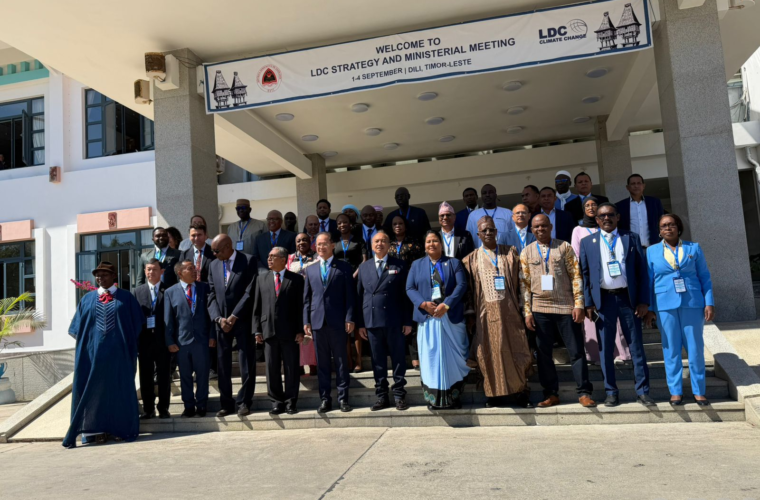
Kathmandu, Sept 3: Minister for Agriculture, Forests and Environment, Gita Chaudhary, has drawn the attention of the world, saying the flood in Bhotekoshi River occurred on August 10 has shown seriousness of climate crisis.
Addressing the ministerial-level meeting of Least Developed Countries taking place in Dili of Timor-Leste today, Minister Chaudhary shared that a catastrophic snow-rock avalanches unfolded in Bhotekoshi river of Rasuwa district in the northern border with China and its loss and damage is unprecedented in scale, and never happened in the past.
She called upon the LDC Group to stand together with a clear and unified voice for climate justice. “We already lost 1,206 people, and more than 4,216 people are still missing. Around 60 thousand people of 15,000 households are displaced,” underlined Minister Chaudhary.
On the occasion, the Agriculture Minister opined, “LDCs including Nepal contributes negligible Green House Gases (GHGs) emissions, but impacted the most. Yet our people are paying an unbearable price for a crisis. This is the profound injustice at the heart of climate change.”
The flood completely damaged 11 hydropower projects having 749 MW production capacity, more than 100 bridges, 118 telecom towers, and around 187 km of national highways, she argued, stating that preliminary assessments of economic loss and damage accounts 4 to 5 billion US dollar while the non-economic losses yet to be calculated, but it might 2-3 folds of economic losses, and, in many cases are irreversible.
As per the preliminary study, a rock-ice avalanche and the sudden blockage and release of river level contributed to the disaster, added Minister Chaudhary.
Saying the first priority of the government was to save the lives and livelihoods, she underscored that the government has forwarded search, rescue, relief, rehabilitation and reconstruction activities with priority.
“We have mobilized our full efforts through security agencies, government officials, local communities, voluntaries, civil society organizations including development partners and media colleagues,” opined the Minister.
Minister Chaudhary stressed on regional partnerships and cooperation for managing river systems keeping the trans-boundary nature of these hazards in mind. Saying Bhotekoshi disaster is just a wakeup call and stark warning of the accelerating climate crisis, she argued that this disaster is neither first nor last.
The Agriculture Minister pointed out the need of bringing the Fund for Responding to Loss and Damage into full operation and it should be made accessible and responsive to countries facing climate catastrophes. Presenting a proposal that Bhotekoshi disaster should be considered for rapid response support through the Fund, she shared that Nepal has already submitted its official request in this regard.
Similarly, she laid emphasis on the need of limiting global temperature rise to 1.5 degree Celsius for the survival and development trajectories of LDCs and mountainous countries.
“The magnitude and duration of any temperature overshoot must be limited. This requires urgent and deeper emissions reductions, particularly from major historical and current emitters,” underscored Minister Chaudhary.
Stating that countries that have benefited most from decades of fossil-fuel-driven growth, and have the greatest capacity to act, carry a particular responsibility to lead in carbon emission, she opined, ” Continued dependence on fossil fuels, the primary driver of global warming must be addressed with urgency in COP31 scheduled at Antalya in Turkey from November 9-20.”
Minister Chaudhary mentioned, “I ask the developed countries to fulfill their obligations under Article 9 of the Paris Agreement by providing new, additional, predictable and grant-based public finance.”
“Mountains must remain central to the UN climate process. Mountain ecosystems provide freshwater and clean air, and provide environmental services to billions of people residing downstream. Mountain communities-particularly Indigenous Peoples and local communities are facing exceptional hardships arising from remoteness, poverty, fragile ecosystems and dependence on climate-sensitive natural resources,” she opined.
She stated that Nepal will call for mountain and climate change to be recognized as a distinct priority at COP31 and for the UNFCCC dialogue on mountains and climate change to be institutionalized as an annual basis.
Stressing the need of interconnecting adaption, disaster risk reduction and development plan, she emphasized that priority should be given in observation systems, transboundary data-sharing, multi-hazard early-warning systems, climate-resilient infrastructure, strengthened institutions and better-prepared communities.
“Nepal has submitted an ambitious NDC 3.0 and stands ready to move from commitment to implementation. Ambition in implementation is critical to protect vulnerable people. The LDCs do not seek sympathy, we are seeking justice, solidarity and implementation,” she argued.
Agriculture Minister Chaudhary opined, “Our people have heard enough promises. They now need tangible action that protects lives, restores livelihoods and builds a resilient future. COP31 must be a COP of implementation, ambition, solidarity and climate justice.”
Stating that Nepal wants to link from Sagarmatha, the Mt. Everest to the Sea approach, from the mountains of Nepal to the coasts of Timor-Leste, she stressed, “Our vulnerabilities must unite us, our solidarity must strengthen us, and our collective voice must deliver climate justice. Climate disasters in the mountains are transnational nature and regional approach is imperative to save the life in the downstream.”
Minister Chaudhary said climate action is therefore not merely a matter of negotiation – it is a matter of humanity, justice and survival, reaffirming Nepal’s full support for the unity and leadership of the LDC Group.