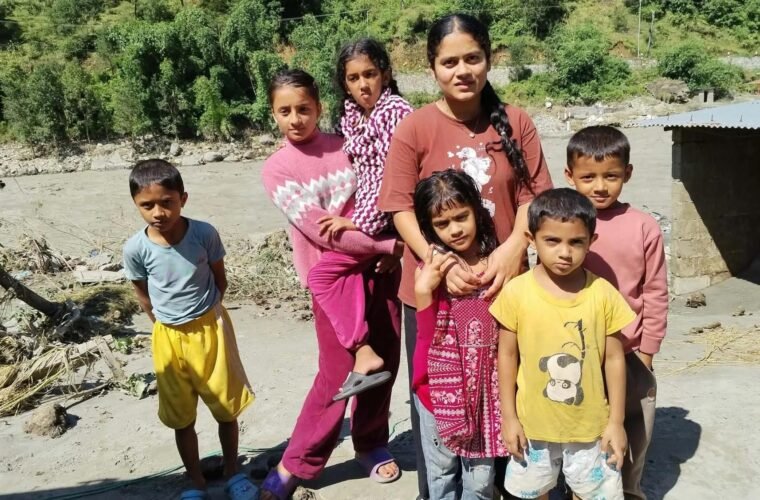
Parbat, Oct 5: Diwas KC, a tenth-grade student at Shiva Secondary School at Pharse in Jaljala Rural Municipality-7, Parbat, experienced a devastating situation when flooding swept away his residence.
The catastrophic event resulted in the loss of his notebooks, textbooks, school uniform, and bags when the Kaligandaki River inundated his home. While relief efforts have addressed food and clothing shortages, educational materials remain largely unattended.
The displaced residents of Lasti have been sheltering in temporary plastic sheds for ten days, with some having relocated to relatives’ homes.
Although food security remains a long-term concern, rice, vegetables, salt, and oil have been distributed to affected households through district and province-level relief initiatives. However, students who lost their educational materials face distinct hardships.
Sulabh Thapa, an eighth-grade student, shared that despite numerous relief distribution groups visiting the village, none have provided books, leaving him repeatedly disappointed. Approximately forty students at the School, situated near the flood-affected Kaligandaki area, lost their school uniforms, textbooks, and writing materials.
The school remains closed, though administrators plan to reopen today following parental consultation.Students now face the challenge of attending classes without proper clothing or supplies. Concerns about examination preparation weigh heavily on the community.
Local resident Parvati Acharya notes that treating flood victims with pity compounds their suffering. She emphasizes the critical shortage of children’s educational materials in the area. Teacher Lakshmi Malla Thapa’s agricultural land was completely destroyed by the flood. As a pregnant woman without shelter, she has been staying with neighbours.
Despite maintaining employment, she struggles to sustain her household with her husband Arjun and three sons. Her immediate financial situation remains precarious.
The condition of those living by farming is even worse off here. Even though people come from different places to see and observe the situation here after the flooding, they haven’t received anything except some food and tarpaulin tents.
Diwas KC, a tenth grader, and his sister Deepa, who studies in class 9, have expressed concern after their books and notebooks were swept away by the floods.
“It is almost time for exams, but I don’t have any books. What should I study? Even if I go to the market to find books, I can’t find any notebooks or books,” Diwas lamented.
So far, more than a dozen relief distribution teams that reached here have not paid attention to this issue affecting children. Instead, it seems the competition among them is which organisation or group distributed the number of sacks of rice and blankets as relief.
If someone or group of people arrive by the side of the road, locals run to see if it’s help, and so far they haven’t even had time to think about their own children’s books and notebooks.
Many people from the district and its surrounding areas have not paid any attention to the problems of the children even when they reach here and collect the data on property loss due to the floods.
Diwas BK, who studies in class 8 at Shiva Secondary School, along with many other students like Remon BK from class 1, Nikita Shah, Kritika Acharya, Bina KC, and Uday BK, have been going to the hillside during the day to dig through the sand in the ruins and the flood-damaged houses looking for their books and notebooks, but in vain.
School principal Amrit Sapkota said, “It’s the middle of the academic year, there’s problem getting books, and we are having a lot of trouble figuring out how to manage school text books for the students to study.”
He said that even a pencil and an eraser are very important to children. He mentioned that he found out about the students’ books and stationery being washed away by the flood only when he met the students. Sapkota said that even if only mud entered the school building, classes would only be conducted based on the advice of the parents, since they had lost their homes.
After the suspension bridge over the Kaligandaki broke, children and a teachers coming from Dhodeni in Baglung are also having a hard time getting to school. The school that used to be just five minutes away now requires a two-hour detour.
The flood on the night of September 27 swept away 71 houses, depositing mud and sand inside, and destroying everything along with the food supplies. The remaining items are also covered by mud. It’s risky to go inside the ruins. There are piles of debris comprising wood and pebbles brought by the river.
“Even though all the goods were washed away, there was rice in the wooden trunk,” local resident Deepa Karki said. “I scraped off the mud on top and dried some of the rice. Let’s see how much of the rice remains after washing it?”
They are also unsure whether to stay in this place or not. There is no land elsewhere for safe residence. Therefore, she said, she has asked the ward chairman to draw the government’s attention to their predicament.
On the other hand, the Jaljala Rural Municipality has started collecting data of the displaced people, and the district administration and municipality are taking initiatives for resettlement, Chairman Raju Acharya informed.