By Dr. Huang Chen
Nepal’s people, their warmth, simplicity and kindness left a lasting impression on me when I first arrived in this beautiful country nestled on the southern slopes of the Himalayas as a member of the Chinese Medical Team. At the same time, my experience also gave me an opportunity to witness some of the challenges facing Nepal’s healthcare sector, particularly the shortage of medical equipment and specialist doctors in remote areas.
I feel honoured to share my experiences of providing medical services in Nepal as a member of the Chinese Medical Team.
I have been serving at the BP Koirala Memorial Cancer Hospital (BPKMCH) in Chitwan, one of Nepal’s leading cancer treatment centres. The hospital receives patients from across Nepal as well as from northern parts of India.
For many people living in mountainous and remote regions, reaching a hospital requires a long and difficult journey. Poor transportation facilities and limited access to healthcare often mean that patients arrive at hospitals only after their conditions have become critical.
When I came to Nepal as a Chinese doctor, I realised that our responsibility extended beyond treating patients and saving lives. We also carried the responsibility of strengthening the longstanding friendship between China and Nepal.
Unforgettable experiences beyond medical treatment
In our daily work, we collaborate closely with Nepali doctors and healthcare professionals, treating patients in hospital wards, administering chemotherapy and providing outpatient services.
Many patients who travel from remote mountainous districts face not only serious health conditions but also financial difficulties and fear of their illnesses. Their struggles have often moved us deeply.
One case that remains particularly vivid in my memory is that of a young woman from the Jhimruk area of Pyuthan district in western Nepal. She was suffering from lymphoma, a type of cancer affecting the blood and lymphatic system.
She was admitted to the hospital after experiencing persistent abdominal pain and vomiting. Her condition had deteriorated rapidly within approximately a month of the onset of symptoms.
She had initially sought treatment at a local hospital in western Nepal. However, due to limited medical resources, doctors were unable to establish a definitive diagnosis. A malignant tumour was suspected, and a tube had been inserted to drain fluid from her abdomen. Despite these interventions, it was difficult to determine a clear treatment plan.
The patient and her husband were deeply distressed. As her condition worsened, she initially struggled to eat and eventually found it difficult even to drink water.
Despite her critical condition and severe financial difficulties, she travelled for an entire day through challenging monsoon conditions to reach BP Koirala Memorial Cancer Hospital, carrying her last hope of recovery.
What led her to choose our hospital was a free medical camp conducted by a Chinese medical team in her village four years earlier.
The 14th Chinese Medical Team had travelled to remote mountainous areas of western Nepal four years ago to provide healthcare services. Local residents had experienced firsthand the dedication and goodwill of Chinese doctors. They had also learned about the continued collaboration between Chinese and Nepali medical professionals.
When I first examined the woman, she was extremely thin and weighed just 38 kilograms. Medical examinations revealed two fist-sized masses in her abdomen.
Working alongside my Nepali colleagues, I carefully discussed her medical condition and jointly developed an appropriate chemotherapy plan, taking into account the available medical facilities and treatment options.
Following the first cycle of chemotherapy, her troubling symptoms disappeared completely. By the completion of four cycles, the tumours in her abdomen had also disappeared.
Stories like hers are not uncommon in our daily practice. Some patients who recover from their illnesses later return to the hospital carrying fruits and vegetables grown in their own gardens to express their gratitude.
Their smiles and a simple, heartfelt ‘Namaste’ are among the most valuable rewards we receive for our work.
Building local expertise, not just treating patients
Years of medical experience have taught me an important lesson: providing medical assistance in Nepal should not be limited to treating a certain number of patients and returning home.
More importantly, it should involve strengthening the skills of local healthcare professionals and helping build a capable Nepali medical workforce that can continue delivering quality healthcare independently in the future.
Therefore, we have prioritised practical training for Nepali doctors and healthcare workers through hands-on demonstrations, clinical case discussions, surgical demonstrations and specialised training programmes.
Over the past year, we have provided training to more than 500 Nepali healthcare professionals in various medical fields.
During this period, we have also introduced approximately 10 new medical techniques, including fracture reduction techniques, ultrasound-guided transperineal prostate biopsy, laparoscopic nephroureterectomy using a single body position and three small incisions, and the use of intracardiac electrocardiography to confirm the tip position of peripherally inserted central catheters (PICCs).
Nepali doctors can now independently perform several procedures, including PICC line placement, basic acupuncture based on traditional Chinese medicine and herbal medicine administration techniques.
Our collaboration also covers specialist treatment techniques, disease diagnosis, clinical procedures and departmental management. We remain committed to gradually enhancing the capabilities of our Nepali colleagues so that they can independently perform increasingly complex medical procedures.
Taking healthcare services to remote villages and mountains
I have led several medical teams to conduct mobile health camps in rural and remote mountainous regions of Nepal.
Reaching these communities is often challenging and risky. Difficult mountain roads, long journeys and language barriers add to the difficulties of providing medical services.
However, the sight of local residents waiting from early morning for their turn and the hope reflected in their eyes constantly reminds us of the importance of our work.
Through these health camps, we have not only provided medical consultations and treatment but also conducted public health awareness programmes. Our efforts have focused particularly on reaching people in remote areas who face difficulties travelling to healthcare facilities.
The trust established during the medical camp conducted in a remote village four years ago has now come full circle. The young woman who travelled such a long distance to seek treatment at our hospital is a powerful reminder of that enduring trust.
This continuity of trust is one of the simplest, most heartfelt and strongest examples of medical cooperation between China and Nepal.
What I have learned from Nepal
My experience of working in Nepal has also given me a new perspective on my own professional journey.
Working in an environment with limited resources has taught us to place greater emphasis on fundamental medical skills, adapt treatment approaches to local circumstances and remain flexible in finding solutions to different medical challenges.
I have been deeply impressed and inspired by the professionalism, sense of responsibility and dedication demonstrated by Nepali doctors and healthcare workers despite limited resources.
Whenever I witness the mutual trust between Chinese and Nepali doctors and their patients, or see medical professionals from both countries working together to overcome difficult challenges, I feel that every effort we make is worthwhile.
China and Nepal are neighbouring countries connected by mountains and rivers. The Himalayas stand as a symbol of our shared relationship.
For more than six decades, China’s foreign medical assistance teams have upheld the spirit of ‘fearing no hardship, dedicating themselves selflessly, saving lives, treating the injured and sick, and embracing boundless love and compassion’.
This spirit of service continues to guide our work in Nepal.
A spirit of humanitarian service higher than the Himalayas
Medical service knows no boundaries. Human compassion and dedication can cross even the highest mountains.
My experience of providing medical assistance in Nepal has become one of the most meaningful and unforgettable journeys of my professional life.
Looking ahead, I hope to continue serving as a bridge for medical exchange and cooperation between China and Nepal. I remain committed to deepening collaboration with Nepali healthcare professionals, contributing to the development of local specialist medical capabilities and helping protect the health of more Nepali citizens.
Through our white coats, may the friendship, trust and warmth connecting China and Nepal continue to grow stronger in the years ahead.
Thank you.
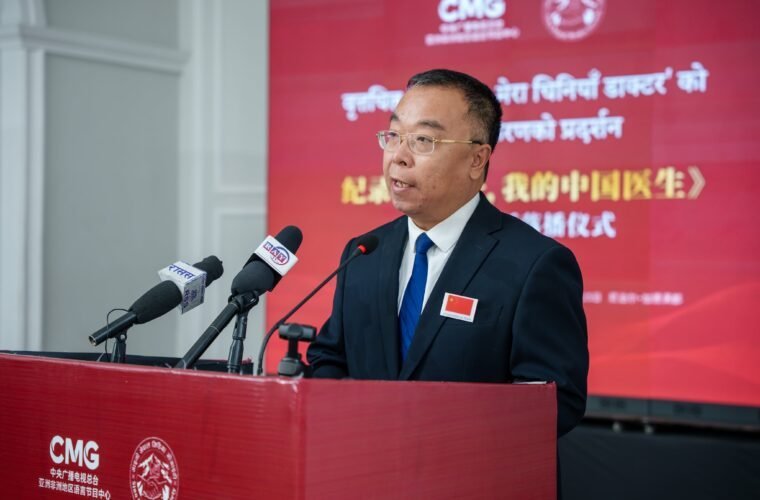
(Dr. Huang Chen is the leader of the 17th Chinese Medical Team in Nepal. This article is based on his remarks at the documentary screening programme titled ‘Hello, My Chinese Doctor’.)