Sharachchandra Bhandary, Kathmandu, Aug 12: After initially preferring to meet foreign ambassadors collectively, Prime Minister Balendra Shah has now held separate one-on-one meetings with the ambassadors of Nepal’s two immediate neighbours, India and China.
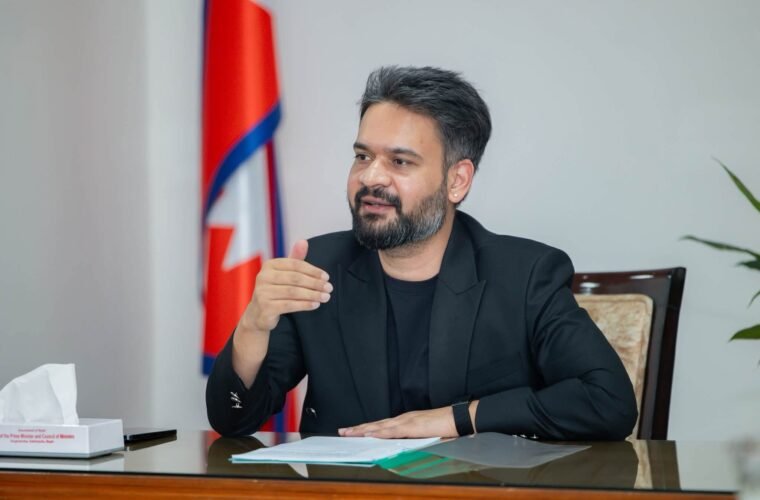
On Monday, Shah met Indian Ambassador to Nepal Naveen Srivastava and Chinese Ambassador Zhang Maoming separately at the Office of the Prime Minister and Council of Ministers in Singha Durbar. The meetings mark a notable shift in the prime minister’s approach to diplomatic engagement and could be seen as an indication of a more pragmatic phase in Nepal’s relations with its two major neighbours.
Soon after assuming office, Shah had adopted a distinctive approach to engagement with foreign envoys. Rather than holding individual meetings, he initially preferred collective interaction with ambassadors. In April, he met ambassadors and heads of diplomatic missions collectively, underscoring his emphasis on institutional channels and diplomatic protocol.
That approach generated considerable discussion in diplomatic and political circles. There was also considerable media attention when the planned visit of Indian Foreign Secretary Vikram Misri to Kathmandu was postponed in May. The visit had been scheduled for May 11, but the government subsequently said it had been postponed. Although some reports linked the postponement to uncertainty over a meeting with Prime Minister Shah, no definitive official explanation established that as the reason.
The latest meetings, therefore, are significant not simply because Shah received two ambassadors, but because they demonstrate a change in practice. Diplomacy cannot be conducted solely through formal correspondence and institutional channels. Direct communication between political leaders and diplomatic representatives is also an important instrument of foreign policy, particularly when a country seeks to build confidence, communicate priorities and identify areas of practical cooperation.
Prime Minister Shah’s meeting with Ambassador Srivastava was his first one-on-one meeting with an Indian ambassador since becoming prime minister. During the meeting, Shah emphasised the need to further deepen Nepal’s historic relationship with India and work together in areas of shared interest. Srivastava conveyed greetings from Indian Prime Minister Narendra Modi and said on X that the two sides discussed further deepening the robust and multifaceted India-Nepal partnership.
Later the same day, Shah met Chinese Ambassador Zhang Maoming. According to the Prime Minister’s Secretariat, the meeting discussed further strengthening Nepal-China relations, expanding cooperation in various fields and enhancing the development partnership between the two countries.
The fact that Shah met the representatives of both India and China separately on the same day carries a broader diplomatic significance. It suggests that Nepal intends to engage both neighbours independently rather than viewing its relationship with one through the prism of the other.
This is also consistent with the foreign-policy framework outlined by the government. Nepal has stated that it remains committed to strengthening its longstanding bilateral relations with India and China independently, on the basis of sovereign equality, mutual respect, mutual benefit and sensitivity to each other’s legitimate interests and concerns.
For Nepal, however, neighbourly relations are not merely a matter of geopolitics. They are closely connected with the country’s economic transformation. India and China are among the world’s largest and fastest-growing economies, and their continued development presents Nepal with opportunities to expand trade, attract investment, strengthen connectivity, promote tourism and deepen economic cooperation.
This explains why economic diplomacy has been placed at the centre of Nepal’s external engagement. The government has sought to use diplomatic relations to promote trade, investment, technology transfer, tourism, education and innovation.
Nepal’s location between India and China is also increasingly being viewed as an economic opportunity. The Shah government’s stated aspiration is to transform Nepal from a landlocked country into a dynamic bridge connecting China and South Asia. Cross-border transport connectivity, digital connectivity, trade facilitation and the movement of goods, services, investment, technology and knowledge are central to that vision.
Against this backdrop, maintaining meaningful dialogue with both neighbours is not a matter of diplomatic courtesy alone. It is closely tied to Nepal’s development interests. India remains a major partner in Nepal’s trade, energy cooperation, tourism, infrastructure and cross-border connectivity, while China represents important opportunities in infrastructure, trade, investment, tourism, technology and development cooperation.
The challenge for the Shah government is therefore not to choose between India and China, but to engage both effectively while preserving Nepal’s policy autonomy and ensuring that bilateral relations generate tangible national benefits.
India has formally invited Prime Minister Shah to make an official visit, although no date has been fixed. New Delhi confirmed the invitation on July 28.
The next phase will therefore be more consequential than the meetings themselves. If the new diplomatic engagement leads to concrete progress in trade, investment, energy, connectivity, technology and development cooperation, Prime Minister Shah’s shift from collective to direct diplomatic engagement could prove to be more than a change in protocol—it could become an important component of Nepal’s economic diplomacy.
For a country situated between two major powers, diplomatic isolation is hardly a viable option. Nor is aligning too closely with one neighbour at the expense of the other. Nepal’s sustainable course lies in engaging both with confidence, maintaining strategic autonomy, respecting legitimate concerns and ensuring that its relations with India and China serve Nepal’s national interest and long-term development.