Lamjung, July 10: Harsingdanda in Marsyangdi Rural Municipality-3 of Lamjung has developed into a popular choice for domestic tourists over the past few years.
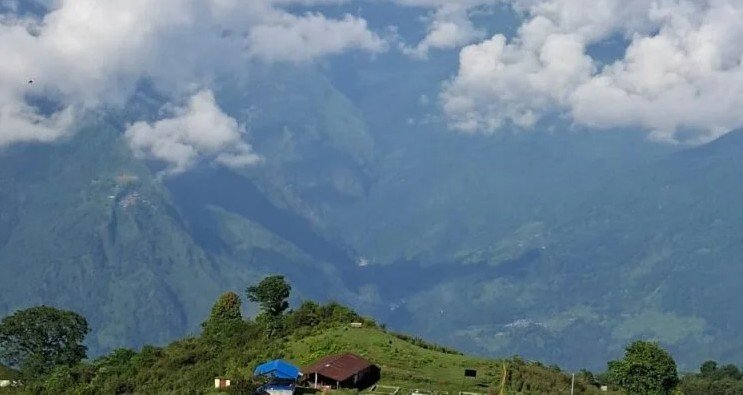
This historic hill, associated with the childhood of national hero Bhakti Thapa, has been attracting tourists due to its natural beauty, scenic view of the Himalayas, peaceful environment, and historical significance.
This place’s identity as touristic place has gained new dimension after electricity reached here. A few days ago, the Nepal Electricity Authority’s Lamjung Distribution Center extended the national transmission line to Harsingdanda, and now in the evenings, the hill looks beautiful when lights are on.
Locals of Harisingdanda who had been relying on solar power for their daily power needs for a long time now have regular electricity. This has not only made daily life easier for the locals but also given a new boost to the tourism business.
It is expected that the tourism business will thrive once electricity is available.
A few years ago at that place, four youths—Purna Bahadur Gurung, Suman Gurung, Suraj Gurung, and Indra Bahadur Gurung—jointly invested about Rs 1.1 million to build a conference hall with a capacity of accommodating up to 35 people, along with food and lodging facilities for the visitors.
It’s because of this initiative by the local youth that domestic tourism has started to increase at this historic site.
Nowadays, hundreds of tourists come here in different seasons. Local residents believe that sales of locally produced farm produce to handicraft will increase, young people will get jobs in the village, and the village’s economic activities will expand. Harsingdanda, which used to become deserted as soon as evening fell, is now charmingly bright.
Tourists visiting Harsingdanda have been captivated by the natural beauty here.
According to them, the view of the Manaslu mountain range, the Buddha Himal, Dr. Hark Peak, the view of the Marsyangdi River with its serpentine bends, Ghalegaon, Kalmedanda, Besisahar Bazaar, and even up to Bandipur in Tanahun is truly enchanting. The mesmerizing sunrise and sunset make anyone who visits here want to come back again.
Harsingdanda has become an excellent destination not just for short walks, but also to spend a night or two enjoying time with friends and family. Its peaceful atmosphere, local hospitality, natural beauty, and history connected to historic military commander Bhakti Thapa make it even more delightful.
Another important aspect of Harsingdanda is its historical significance. It is a place the new generation must visit at least once to understand Nepal’s heroic history.
It is mentioned in history books that the national luminary Bhakti Thapa, who was born in 1802 BS at Dhungbensi, Khuudee, currently in Marsyangdi Rural Municipality–3, spent much of his childhood grazing livestock on this hill.
It is said Thapa used to enjoy shot-put competitions, play with friends, and grow up in the village environment at this place.
His statues and memorial parks dedicated to Bhakti Thapa have been built in various places in Lamjung in honor of his bravery during the Anglo-Nepal battle.
But the Harsingdanda where he spent his childhood days has only recently started to catch up with development. Locals say that with the expansion of roads, electricity, and tourism infrastructure, the importance of this place has been steadily increasing.
Bhakti Thapa Chhetri (1741 A.D. Lamjung, Nepal – 1815 A.D.) was a military commander and administrator in the Kingdom of Nepal. Initially, he served the Kingdom of Lamjung. He is considered one of the national heroes of Nepal.
Sardar Bhakti Thapa had great success in the unification of the Jumla District. He was involved in the Anglo-Nepali War. His most important contribution to the war was at the western front of Deothal.
Historical accounts have it that in the Anglo-Nepal war, Sardar Bhakti Thapa was controlling the operation of the whole Western Region of Nepal from the fort of Malaun, whereas the fort of Surajgadh was in the south of this fort.
As the British forces had control over the fort of Deuthal, 1,000 yards (910 m) away from Malaun fort, the whole of the Western Region was at stake, which made Sardar Bhakti Thapa Chhetri go to the battlefield, taking naked Khukuri and sword on his hand, along with 2,000 Nepali soldiers amidst the fierce gun-firing of the British army on April 16, 1815.