Kathmandu, Aug 5: The government has initiated efforts to collect the money that internet service provider (ISP) companies owe for telecom service fees, license fees, and the Rural Telecommunications Development Fund (RTDF).
The Ministry of Information and Communications has started discussions and procedural work with the concerned parties to resolve the long-standing dispute related to outstanding amounts, tax assessment, and license renewal.
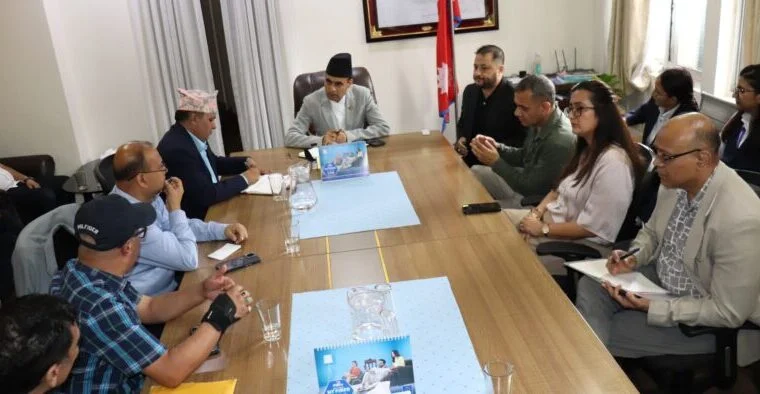
Information and Communications Minister Dr. Bikram Timilsina today emphasized in a discussion with officials of the Internet Service Providers’ Association Nepal (ISPAN) that taxes and fees that must be paid according to the law should be deposited into the state treasury no matter what.
“If there has been a tax or fee imposed on an internet service provider in a way that is unjust and against existing law, the government can review it. But the amount that the law says must be paid cannot be just left hanging. If there is a legitimate issue, the government will address it, otherwise the process of collecting the dues will move forward,” he said.
Communications Minister Dr. Timilsina mentioned that the government is for making this fiscal year as a year for improving the telecommunications sector and said that long-standing policy and administrative issues that have not been resolved for years will be finalized.
He urged ISPAN to clearly present the problems faced by service provider companies, the expectations from the government, and the aspects that need improvement as written suggestions.
The regulatory body, Nepal Telecommunications Authority (NTA), has been saying that it cannot renew the licenses of internet service provider companies until the outstanding payments are settled.
In the discussion, Communications Minister Dr. Timilsina said that one shouldn’t expect to operate services or renew permits without paying the amounts required by law.
He stated that since there are many internet and telecommunications service provider companies in Nepal, it has become challenging to regulate and monitor them effectively, and suggested that these companies could potentially be taken to a merger or acquisition process.
Minister Timilsina said that it is beneficial for both consumers and regulators to have a limited number of capable and financially strong service providers rather than a large number of weak companies operating.
ISPAN has stated that the service provider companies are under serious financial pressure and it is not possible topay off arrears for five years at once, and has requested arrangements for installment payments.
ISPAN has emphasized that there should be a facility to pay the outstanding amounts in installments, especially for solicitation fees and the Rural Telecommunications Development Fund.
According to ISPAN, most service providers are facing more problems after the Nepal Telecommunications Authority decided not to renew the licenses of companies that don’t clear their dues.
The halt in license renewal has affected service expansion, banking operations, and business activities. ISPAN has also reiterated the need to review the determination of telecom service charges (TSC) and demanded that big taxpayers be given the opportunity for reassessment of taxes determined by the big taxpayer office.
Service providers had complained that they were forced to pay taxes even on the amounts they hadn’t actually collected from customers.
Currently, most internet service providers still need to pay a four percent royalty on total revenue to the Ministry of Information and Communications, in addition to the taxes they owe to the Inland Revenue Office, and a two percent contribution on total revenue to the Rural Telecommunications Development Fund through the Nepal Telecommunications Authority.
Even though the NTA has repeatedly issued circulars to submit these amounts along with additional fees to the relevant body based on financial statements audited according to prevailing law, the service providers have been ignoring them.
The Office of the Auditor General has also been pointing out in its annual report that fees yet to be collected from service provider companies, rural telecommunications development fund, and other charges remain outstanding and has been emphasizing that these amounts need to be recovered.