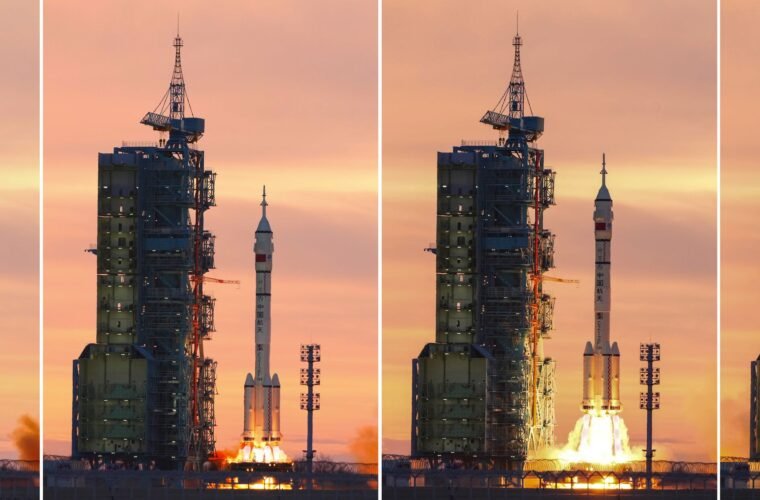
Reuters : Pakistan’s Zeeshan Ali is soon to be the first foreign astronaut to board China’s Tiangong space station, marking a historic moment for his country’s science ambitions and Beijing’s efforts to extend its space diplomacy.
The Shenzhou-24 space flight docked at Tiangong at 11:56 a.m. (0356 GMT) Wednesday, roughly 3-1/2 hours after it took off from the Jiuquan Satellite Launch Centre in northwest China using a Long March-2F rocket.
The 40-year-old pilot, who has become the first Pakistani in orbit, will work as a payload specialist and is set to stay at the station for 5 to 10 days.
He is accompanied by Chinese commander Tang Hongbo and flight engineer Wu Yi.To prepare for the flight, Ali trained for seven months in Beijing, during which he underwent intensive Chinese-language classes, learning Chinese songs and reading Chinese poetry. He also practised calligraphy and played table tennis.
“I’m not flying for myself. I carry the name of Pakistan on my shoulder,” Ali told reporters on Tuesday.
China is promoting Tiangong, which means Celestial Palace in Chinese, as a hub for international cooperation while the NASA-led International Space Station faces possible retirement by 2030.
Though Ali’s planned stay is much shorter than the usual six-month rotation for a Chinese astronaut, it has been cause for huge celebration in Pakistan.
“This is not just one astronaut’s journey, but the journey of 240 million Pakistanis. It is the journey of our younger generation, our scientists and our dreams,” Pakistani Prime Minister Shehbaz Sharif said in a post on X.
“This is living proof of the ironclad friendship between Pakistan and China. We are grateful to our brother country, China, for making Pakistan part of this historic mission.”
Space cooperation between China and Pakistan dates back to the early 1990s. China has launched Pakistani satellites and a Pakistani-built rover is also set to fly on a Chinese lunar mission around 2028.
While in space, Ali will help conduct experiments, including one that will look at how self-healing carbon fiber composites can automatically repair small cracks in spacecraft.