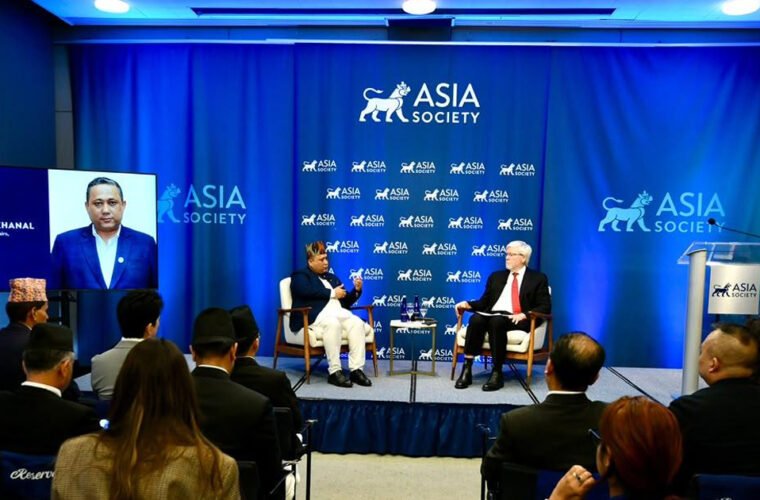
Kathmandu, Sept 25: Minster for Foreign Affairs, Shisir Khanal, said that Nepal should be advanced as an economic, digital and strategic bridge of the Asia, transforming its geographical position into an opportunity amidst Asia’s rising economic and strategic influence.
In his address to a programme ‘Steering Nepal’s Future in Asia’s Rising Century ‘, organized by Asia Society in New York on Thursday, he argued Nepal should not view its geographical challenges as a limit to its national aspirations.
Khanal emphasized the need to change the perspective of seeing Nepal traditionally as a ‘small country’, highlighting its strategically important location, Foreign Minister’s personal secretariat stated.
“Nepal is not small, but is strategically located in the right place,” Minister Khanal said. “The size of our neighbors is a geographical reality, but it should never become a limit to our aspirations.”
He also stressed that Nepal’s geography and population should not be compared with other countries to simply label it as a small country.
Referring to the recent flood, Minister Khanal described it as a ‘Himalayan tsunami.’ “Nepal has long faced natural disasters, difficult geography, and structural challenges,” he said, noting the recent disaster sends a clear message that climate change should be taken as a strategic priority in Nepal’s foreign policy.
He further argued to place priority to devise effective early warning systems, exchange of water-related data, climate finance based on predictable grants, and practical cooperation with neighboring and international communities.
Dubbing Asia’s rise as an important opportunity for Nepal, he pointed out that nearly 60 percent of global population reside in Asia and that Asia contributes significantly to the global economy.
Minister Khanal said Kathmandu can be developed as an important center for Asia’s economic and social transformation. “Our question is no longer how Nepal will survive between two big neighbors. Our question is—how will Nepal navigate between and beyond.” He said the birthplace of Gautam Buddha, Lumbini, along with national luminaries like Araniko and Bhaktuti, has made Nepal an important hub for Asian civilization and culture. “Our ancestors understood an explicit truth – connections create prosperity, isolation increases poverty,” Minister Khanal stated.
Highlighting that Nepal’s hydroelectric production capacity can be linked with regional economic transformation, he further said clean electricity is being exported from India to Bangladesh.
By expanding production in border special economic zones, Nepal can be connected to the global supply chain, he added.
Emphasizing the need to advance Nepal’s cooperation with its northern neighbor China on practical, commercial, and long-term grounds, Minister Khanal stressed the development of multi-dimensional Trans-Himalayan connectivity, including roads, tunnels, dry ports, air services, digital connections, and cross-border rail.
While Nepal’s future should be shaped by the Nepali people, he welcomed the U.S., Europe, ASEAN, and Latin American countries and among other partners for investment partnerships and collaboration to that end.