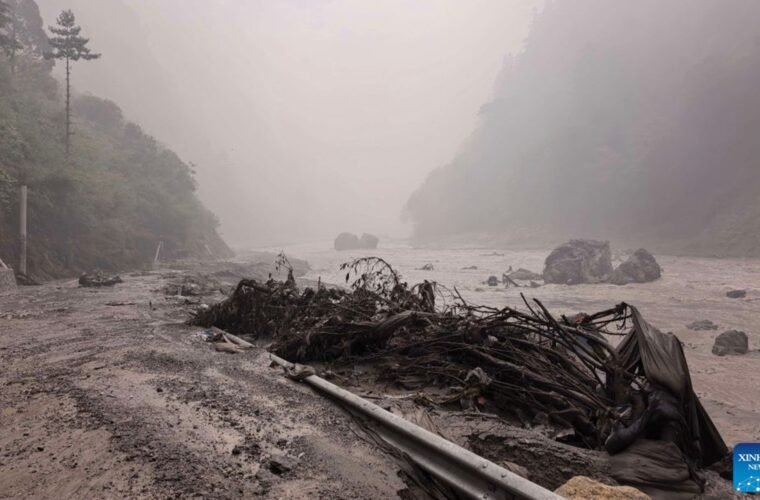
Kathmandu, Aug 29: The Chinese Embassy in Nepal has rejected allegations that China failed to provide Nepal with advance warning of the devastating floods and landslides that recently hit the country.
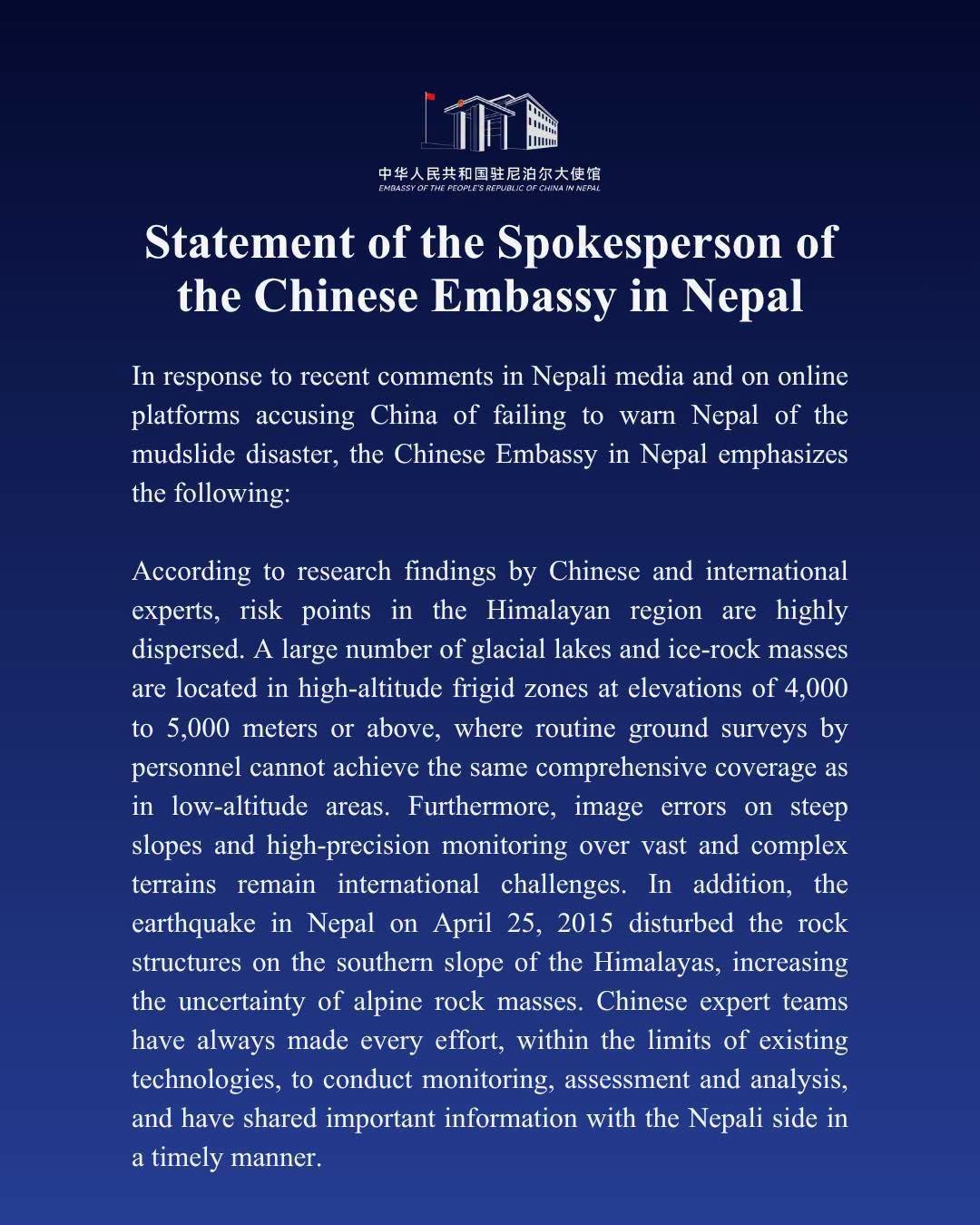
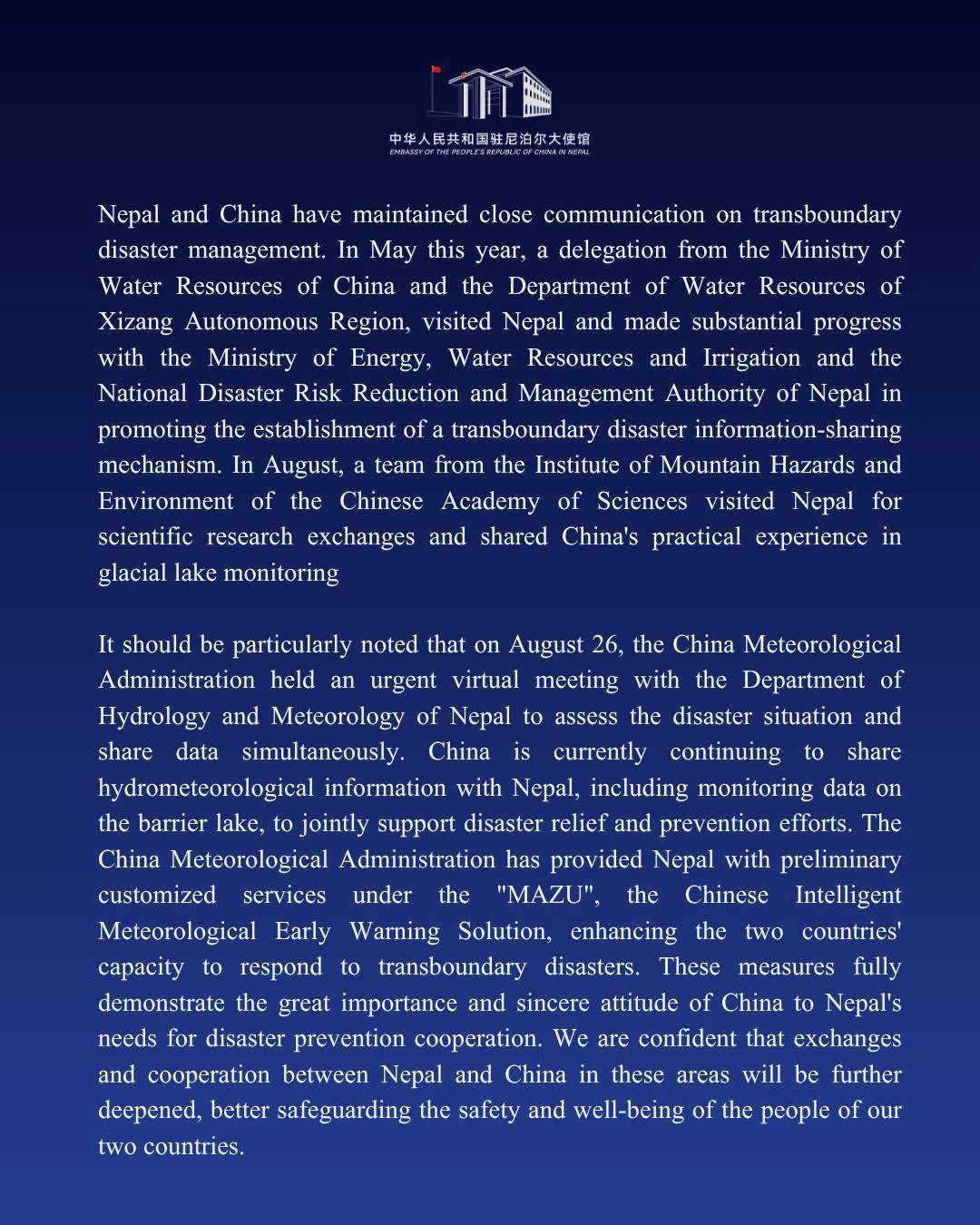
Issuing a statement on Saturday, the embassy said Nepal and China have maintained close communication and cooperation on transboundary disaster management.
It said a delegation from China’s Ministry of Water Resources and the Department of Water Resources of the Xizang Autonomous Region visited Nepal in May and made significant progress with Nepal’s Ministry of Energy, Water Resources and Irrigation and the National Disaster Risk Reduction and Management Authority in establishing a mechanism to share information on transboundary disasters.
In August, a team from the Institute of Mountain Hazards and Environment under the Chinese Academy of Sciences also visited Nepal for scientific research and experience-sharing. The team shared China’s experience in monitoring glacial lakes with Nepali officials, the embassy said.
The embassy said China’s Meteorological Administration held an emergency virtual meeting with Nepal’s Department of Hydrology and Meteorology on August 26 to assess the disaster situation and exchange data.
China has also continued sharing hydrological and meteorological information with Nepal, including information related to barrier-lake monitoring, it said.
The embassy said China’s Meteorological Administration had initially provided Nepal with services tailored to its needs through a Chinese intelligent weather forecasting system known as “BSHG.”
Responding to allegations reported by Nepali media and circulated on online platforms that China failed to provide advance warning, the embassy said identifying and monitoring disaster risks in the Himalayan region is extremely challenging.
According to the embassy, risk points across the Himalayas are widely dispersed, while most glacial lakes and ice-rock formations are located at elevations of 4,000 to 5,000 metres or higher, where extremely cold conditions make extensive ground-based monitoring difficult.
It also said the April 25, 2015 earthquake in Nepal affected rock formations along the southern slopes of the Himalayas, increasing uncertainty over rock structures in high-altitude areas.
The embassy said Chinese experts have continued monitoring, risk assessment and analysis within the limits of available technology and have shared important information with Nepal in a timely manner.
It expressed confidence that cooperation and information-sharing between Nepal and China on disaster prevention and management would be further strengthened in the future.