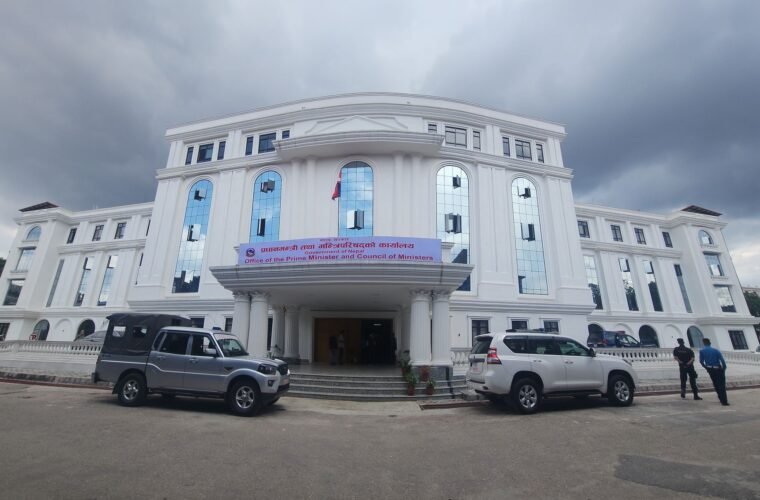
Kathmandu, Aug 7: Four months since the formation of the present government, it has shared some significant achievements in the areas of good governance, administrative reforms, policy implementation, monitoring of development projects, grievances management and legal defense.
According a progress report unveiled by the Office of the Prime Minister and Council of Ministers (OPMCM) on Friday, the government secured 68.26 percent progress towards the capital expenditures and 17.07 percent towards the current expenditures in the past three months.
In the last three months (mid-April to mid-July), the Council of Ministers held 21 meetings, taking 384 decisions and various committees under it conducted eight meetings and took 12 decisions.
Necessary directives were issued through secretary-level meetings to enhance effectiveness in the service deliveries and development endeavors in the aftermath of Gen Z movement while discussions and interactions were also held in parallel towards that end. Office chiefs have been directed to be pro-active and accountable towards to control corruption and promote good governance.
Coordinated efforts among the authorities concerned are underway for effective implementation of the 100-to-do-list of the government. All the ministries and bodies concerned have been directed to address the arrears issues. Guidelines have been prepared for maintaining a zero file, while 49 applications relating to the Right to Information Act- 2064 BS were addressed.
As OPMCM states, the on-site monitoring reports of the Kaligandki Corridor (Gandakot Section), Narayangadh-Butwal (West Section) project under the Ministry of Physical Infrastructure have been prepared and submitted.
In regard to those projects that were remained in limbo for long, sick and incomplete for long, a taskforce formed under the chair at the Ministry of Physical Infrastructure and Transport has so far carried out a detailed analysis of 578 contracts and submitted a report recommending measures for solutions.
On June 10, a decision was made, in the special presence of the Prime Minister’s Advisor on Policy, Administration, and Good Governance, regarding the revival of the Hetauda Textile Industry.
The government approved the PM Delivery Unit (Operation and Management) Directive, 2083 on July2. A preliminary report was prepared after conducting a study and test of the National Fertiliser Policy, 2058. The website of the Office of the Prime Minister and Council of Ministers has updated list of the national policies, which were collected from the concerned ministries. Three programmes were held under Governance Reform Dialogue Series in Siraha, Udayapur and Solukhumbu districts.
A circular was issued to all federal ministries, departments, offices, provincial governments and local levels to ensure cost-effectiveness in public offices. The national commitment made under point no. 3 of 100-point agenda on governance reform was approved by the Council of Ministers meeting on July 2.
A discussion was held with high-ranking officials of the government, stakeholders, related organizations and high-level teams on the progress of the action plan, status of the strategic implementation plan and the upcoming strategy which were set by the International Corporation Review Group (ICRG) under the leadership of the Asia Pacific Regional Anti-Money Laundering Group (APG) from May 18 to 20.
Moreover, an integrated report of OPMCM and its subordinate bodies for 2083 was prepared and made available to the Ministry of Finance. Chief Secretary of the government has endorsed the Institutional Memory Operation and Transfer Framework, 2083 to automate and systematize knowledge management at government bodies. Even the Model Guidelines on Concept Papers, 2083 was approved and implemented to ensure that ministries and agencies enforce the annual budget approved in LMBIS on time, thereby maintaining uniformity in the understanding of the programmes that chips in institutional memory.
15,795 complaints addressed
Hearing and management of complaints were intensified by the government. An omni-channel was put in place for upgrading the complaint management system. As many as 44,340 complaints received through the Hello Sarkar web portal, Facebook, Viber, X, email, Nagarik App, telephone and other direct channels were forwarded to the concerned bodies. Out of these, 17,354 complaints were addressed by the related offices, while 15,795 complaints were settled fully. During this period, total number of complaints resolved amounted to 32,067 which included those received from Hello Sarkar electronic complaint management portal.
152 written responses
OPMCM prepared 152 written responses, appeals and responses combined for the cases received from the Supreme Court, High Court and District Courts which had made defendants to the Prime Minister, Government of Nepal, Council of Ministers, Chief Secretary and the Office of the Prime Minister and Council of Ministers.
The draft of the Sixth National Action Plan on Human Rights (Fiscal Year 2083/84-2087/88) was discussed in Sudurpaschim, Karnali, Lumbini and Koshi Provinces and opinions and suggestions garnered accordingly. The action plan has been finalized and submitted to the Council of Ministers following the discussion with the federal ministries, the Constitutional Commission and the concerned government bodies. The document was finally approved by the meeting of the Council of Ministers on July 8.
OPMCM stated that the Second National Strategy and Action Plan on the Implementation of the United Nations Convention against Corruption was endorsed by the Cabinet meeting on July 8.