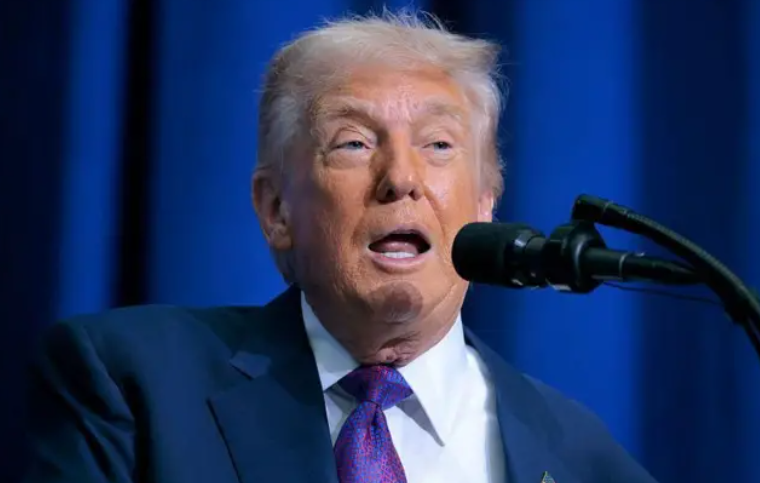
BBC: US President Donald Trump delivered his latest ultimatum to Iran on Thursday during a meeting of the Board of Peace, the Middle East coalition Trump formed to stabilise a region he could soon plunge into a new, weeks-long war.
The irony of simultaneously calling for peace and threatening military action underscored the competing impulses at the heart of Trump’s foreign policy in his second term.
Perhaps nowhere is that contradiction clearer than the impasse between Washington and Tehran – a standoff that has quickly escalated and could now lead to the largest US air campaign in years.
Trump has said he prefers a diplomatic solution in the form of a deal that ends Iran’s nuclear weapons programme. A White House official said on Wednesday that Iran would be “very wise” to strike an agreement.
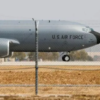
Yet for all the talk of diplomacy, Trump has ramped up his rhetoric against the Islamic Republic in recent weeks, and ordered what analysts say is the biggest US military buildup in the Middle East since the Iraq War in 2003.
It is another striking example of Trump’s willingness to use military force more often than supporters had expected in his second term, and without prior approval from Congress.
Trump’s threat to strike Iran cannot simply be dismissed as a negotiating tactic, since the last time he threatened an adversary with military action the US followed through with its attack on Venezuela in January.
That operation had a narrow military objective, at least as defined by the administration, and ended with the successful capture of former President Nicolás Maduro.
With Iran, the rationale for another military campaign is far less clear.
Trump does not want Tehran to develop nuclear weapons, a priority shared by US allies.
The Islamic Republic, which has been weakened by economic sanctions and mass protests against the regime led by the country’s Supreme Leader, Ayatollah Ali Khamanei, has signalled it’s open to negotiate on the issue of uranium enrichment.
The indirect talks between the US and Iran have stalled over the administration’s insistence that Tehran also curb its ballistic missile programme and support for proxy groups in the region.
But while the negotiations may have deadlocked, Trump hasn’t spelled out why attacking Iran again now – less than one year after a US strike last June – will yield the outcome he’s after.
Trump has insisted the US strike on Iran last year “obliterated” the regime’s nuclear facilities.
The president hasn’t offered an explanation of why another strike is needed, if that is the case, or what, exactly, the new targets might be.
And unlike in Venezuela, Trump’s broader objectives in Iran remain something of a mystery. Does the administration want to usher in regime change in Iran?
Is the US prepared for an Iranian military response that would target American military bases in the region?
How might a prolonged conflict affect America’s other strategic goals in the Middle East, including the Board of Peace-led process to rebuild Gaza?
Trump has offered few details on his thinking about potential day-after scenarios.
Israel’s role in a potential attack also remains unclear. Israel joined the US in striking Iran last year, and is widely expected to participate again if Trump launches a new military campaign.