(Reuters) : The United States and Israel pounded Iran on Tuesday with what the Pentagon and Iranians on the ground called the most intense airstrikes of the war, despite global markets betting that President Donald Trump will seek to end the conflict soon.
Raising the stakes for the global economy, Iran’s Islamic Revolutionary Guard Corps said it would block oil shipments from the Gulf unless U.S. and Israeli attacks cease.
The Reuters Iran Briefing newsletter keeps you informed with the latest developments and analysis of the Iran war. Sign up here.
The Revolutionary Guards also said it fired missiles on Tuesday evening at Qatar’s U.S.-operated Al Udeid base and the Al Harir base in Iraq’s Kurdistan. Those launches were followed by drone attacks targeting a gathering of U.S. troops at Al Dhafra air base in the United Arab Emirates and Juffair naval base in Bahrain.
Early on Wednesday, Iranian state media reported another round of attacks was unleashed on U.S. military installations in Bahrain. Waves of Iranian missiles also were fired at central Israel early on Wednesday. The sound of explosions from air defenses intercepting the rockets punctuated the predawn darkness as air raid sirens blared and Israelis scrambled to safe rooms and shelters. There was no immediate word of whether any of the missiles reached the ground.
S destroys mine-laying vessels as Trump warns Iran over Strait of Hormuz
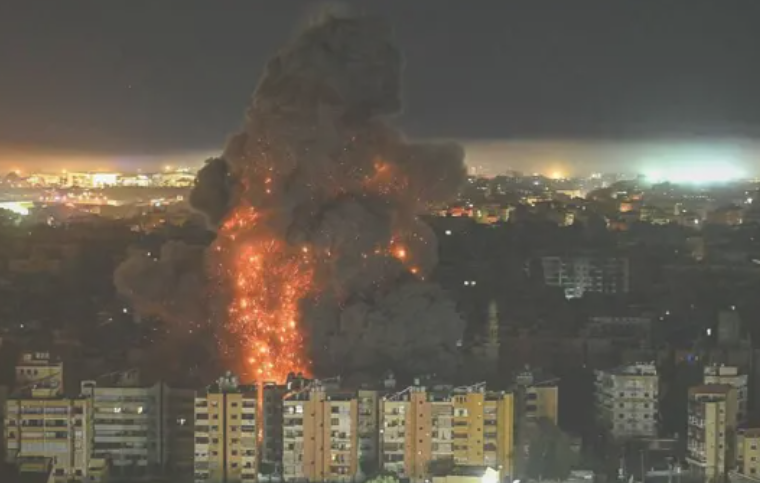
The latest attacks from Iran roughly coincided with a new Israeli barrage on Beirut aimed at rooting out the Iran-backed group Hezbollah, which has fired into Israel from Lebanon in solidarity with the Tehran government.
The White House on Tuesday reiterated Trump’s threat to hit Iran hard over moves to stop the flow of energy supplies through the Strait of Hormuz, where the war has effectively halted one-fifth of the world’s oil and liquefied natural gas shipments, and repeated his offer for the U.S. Navy to safely escort tankers.
“Today will be yet again, our most intense day of strikes inside Iran: the most fighters, the most bombers, the most strikes, intelligence more refined and better than ever,” U.S. Defense Secretary Pete Hegseth told a Pentagon briefing.
In a message posted to his Truth Social platform later in the day, Trump said, “Within the last few hours, we have hit, and completely destroyed” 10 of Iran’s “inactive” mine-laying vessels. He did not clarify where the strikes occurred.
Tehran residents reached by Reuters described the war’s most intense night of bombardment. “It was like hell. They were bombing everywhere, every part of Tehran,” a resident said by phone, speaking on condition of anonymity for security reasons. “My children are afraid to sleep now.”
In Tehran’s east, two five-storey residential buildings were hit on Monday, blasting out floors and walls and leaving a rickety concrete frame. Footage from Iran’s Red Crescent showed rescuers there carrying a victim in a body bag. Workers were still recovering bodies at the site on Tuesday when a missile struck a road intersection nearby.
Yet with Trump having described the war on Monday as “very complete, pretty much”, investors appeared convinced he would end it soon – before the disruption to global energy supplies caused a worldwide economic meltdown.
An historic surge in crude oil prices on Monday to nearly $120 a barrel was reversed as Brent crude settled back down below $90 on Tuesday. Asian and European share prices staged a partial recovery from earlier precipitous falls, and Wall Street bounced around its late February levels, before the war.
White House press secretary Karoline Leavitt told reporters on Tuesday that the American public will see oil and gas prices drop rapidly once the objectives of the joint Israeli-U.S. air war are fully achieved.
A source familiar with Israel’s war plans told Reuters the Israeli military wanted to inflict as much damage as possible before the window for further strikes closes, under the assumption Trump could end the war at any time.
Israel’s foreign minister, Gideon Saar, said the war would proceed until his country and the U.S. determine the time had come to cease hostilities, but that Israel was not seeking an “endless war.” “We will continue until the minute that we, and our partners, think that it is appropriate to stop,” he said.