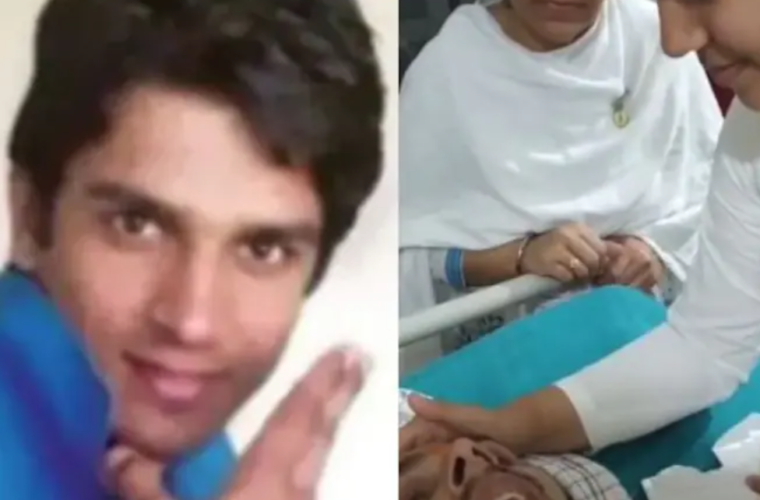
New Delhi: The first Indian to be allowed passive euthanasia has died after over 13 years in a coma. Harish Rana died at AIIMS Delhi, nearly two weeks after the Supreme Court allowed the withdrawal of life support following his parent’s request. The 31-year-old was admitted to the AIIMS on March 14 for the euthanasia process. Two days later, the process was started to withdraw his life support. Eleven days since, Rana breathed his last.
13 Years In Coma
Rana had been in a vegetative state for 13 years after an accident. In 2013, then a student at Panjab University, he had fallen from the fourth floor of a paying guest accommodation. The fall resulted in serious brain injuries. He was later discharged, but the brain injury left him in a coma. Put on life support, he was confined to his bed. He had a tracheostomy tube for respiration and a gastrojejunostomy tube for feeding.
As years went by and hopes of his recovery dimmed, his parents eventually reached the court with a request to allow passive euthanasia.
The Landmark Judgment
On March 11, the Supreme Court granted Rana the ‘right to die with dignity,’ allowing the country’s first-ever legally approved passive euthanasia case. “The medical report shows no improvement in 13 years,” the court said, noting that the doctor’s duty to treat a patient “no longer sustains when the patient has no hope of recovery.”
The top court also urged the government to bring a law on passive euthanasia.
A Death With Dignity
Three days after the landmark judgment, Rana was shifted to a palliative care unit at the AIIMS from his home in Ghaziabad. The court had directed that it must be ensured that medical treatment is withdrawn with a tailored plan so that Rana’s dignity is maintained. As per the court order, a specialised team of doctors was constituted to oversee the final process that included the withdrawal of Rana’s artificial nutrition support and other life support treatment.
Headed by Dr Seema Mishra, head of the department of anaesthesia and palliative medicine, the team comprised doctors from neurosurgery, onco-anaesthesia, and palliative medicine, and psychiatry departments.
Under the team’s observation, the first-ever passive euthanasia was carried out. Rana died in peace at 31.
Passive Euthanasia In India
Passive euthanasia was legalised in India in another landmark judgment over a decade earlier. The order came in the Aruna Shanbaug vs Union of India case in 2011. The court had then rejected a petition for a passive euthanasia plea for Shanbaug, a nurse who had been in a vegetative state for over four decades after a sexual assault. The rejection followed as the staff of the hospital where she was being treated wanted her to live. Shanbaug died of pneumonia in 2015.