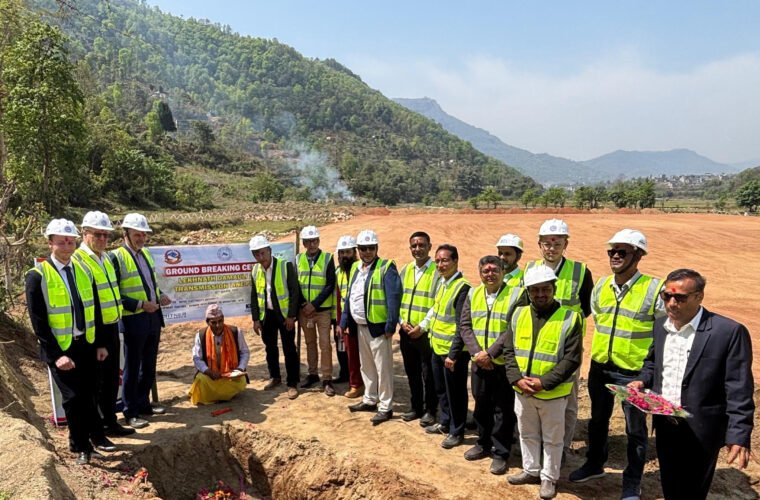
Kathmandu, March 18: The Nepal Electricity Authority (NEA) has laid the foundation stone for the construction of Lekhnath-Damauli 200-KV Transmission Line project.
The event held at the Damauli Sub-station in Tanahun district today was attended by Managing Director of the NEA, Hitendra Dev Shakya, German Ambassador to Nepal Udo Völz, KfW Development Bank Director for Bangladesh and Nepal Michael Sumser and other stakeholders.
The German Embassy in Kathmandu has stated that around 45-kilometer-long 220 KV double-circuit transmission line will be constructed and modern ‘gas-insulated substations’ will be established in Lekhnath and Damauli under the project, co-financed by the German government through KfW Development Bank.
The project with a transmission capacity of around 1,000 MW will strengthen the regional electricity network and ensure effective transmission of electricity generated from hydropower projects, including Tanahun Hydropower Project.
By increasing reliability of the grid and promoting inclusion of renewable energy, it is expected to make substantial contribution to Nepal’s sustainable economic development and energy security.
In this connection, German Ambassador Völz said, ‘In order to meet Nepal’s growing energy demand, the expansion of reliable transmission infrastructure is a must. The German government is proud to cooperate with Nepal to strengthen its electricity network and utilize its vast renewable energy potential. Such projects help deliver clean energy to households, businesses, and industries, contributing to sustainable economic growth.’
The project also reflects the expanded energy cooperation between Nepal and Germany. German financial cooperation has been contributing to Nepal’s energy sector for decades, beginning with the Lower and Medium Sringdi Hydropower Projects.
Along with the expansion of Nepal’s electricity system, the cooperation has focused on strengthening transmission infrastructure, providing support for the Chilime–Trishuli transmission line and the National Load Dispatch Center.
Additionally, it has contributed to approximately 55 MW of solar energy generation capacity in Nepal.
In the coming days, German financial cooperation is expected to focus more on strengthening the electricity distribution system, which is anticipated to ensure reliable electricity supply for consumers and businesses, is stated at the event.
Along with these physical infrastructure investments, German technical cooperation operated through ‘GIZ’ supports policy, system, and capacity development, ensuring that the direct benefits of electricity infrastructure expansion reach the people.