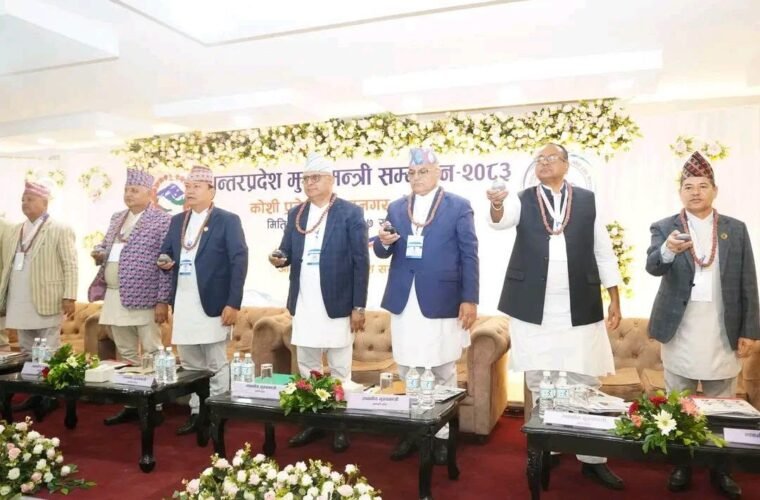
Biratnagar, Oct 14: The Inter-Provincial Chief Ministers Conference concluded, laying emphasis on the implementation of federal governance systems based on the sharing of state powers, co-existence and coordination among the federation, province and local levels as provisioned in the Constitution of Nepal.
In the joint Declaration issued after the two-day conference organized by the Koshi Province government, consensus was reached on operating all three levels of government according to the constitutional provisions and further strengthening the federal governance systems.
As per Articles 56, 57, 59, 60, and 232 to 236 of the Constitution and the relevant schedules, the solid basis for governance should be established according to the division of powers, responsibilities, resource mobilization, and inter-provincial coordination and cooperation.
It was noted that challenges such as unclear jurisdiction, overlap of responsibilities, delays in lawmaking, employee and structural management issues, insufficient financial resources, incomplete transfer of federal assets and liabilities, and intergovernmental coordination exist in the process of implementing federalism.
The Koshi Province Conference expressed agreement on topics included in the Sustainable Development Goals, Nepal Government’s Sixteenth Plan, and periodic plans, policies, and priorities of all seven provinces, concluding that the effective use of constitutionally granted provincial powers, good governance, and citizen-centered service delivery are the foundation of strengthening federalism.
The chief ministers attending the conference expressed consensus by embracing shared issues as key outcomes of inter-provincial cooperation, such as citizens’ income, employment, productivity, food and nutrition security, education, health, safe housing, drinking water and sanitation, social security, access to services and opportunities, entrepreneurship, skill development, governance, environment, conservation, and climate resilience.
By utilizing the country’s natural resources, production, human resources, geographical characteristics, and diverse economic potential as opportunities, it expressed shared commitment to promote agriculture and exports, tourism, infrastructure, energy, natural resources, rivers and watersheds, disaster management, youth and innovation, markets, digital connectivity, and the use of artificial intelligence.
The declaration includes topics such as the implementation of federalism and full exercise of constitutionally granted provincial powers, clarity of work responsibilities, policy and legal issues to be presented to the federal government regarding the transfer of remaining powers, review of federal law making, amendment and expansion of functions, implementation of administrative federalism, provincial police administration and law and order, transfer of federal offices, property, liabilities and records to eliminate duplication, effective implementation of financial federalism and revenue sharing of natural resources, interprovincial projects and infrastructure development, clarity of project and program levels, and implementation of provincial rights.
It also covers interprovincial priority major partnership programmes, joint development and prosperity corridors, equitable use and benefit-sharing of natural resources, climate and disaster risk management, joint commitments, full implementation of the Constitution and strengthening of federalism, constitutional functional relations between provinces and local levels and respect for local autonomy, good governance, transparency, and outcomes.
On the occasion, Koshi Province Chief Minister Hikmat Kumar Karki claimed that the two-day Biratnagar conference was successful in further strengthening the country’s federal system and noted that meetings with the Prime Minister would soon be arranged to discuss the issues included in the ongoing declaration.