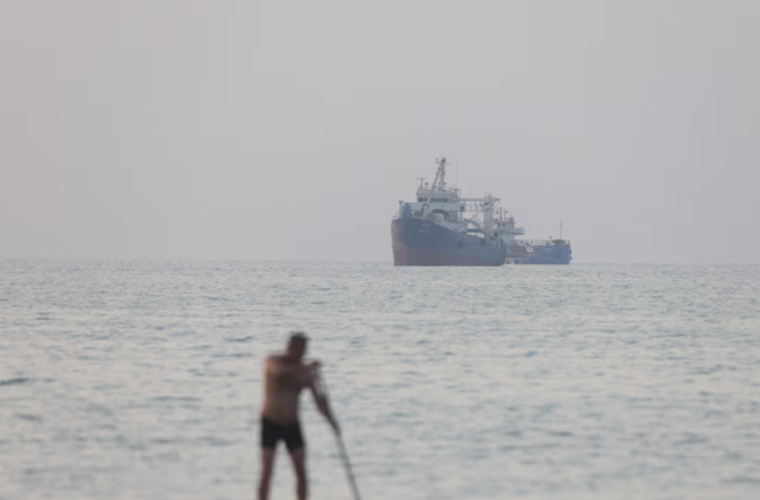
Reuters : The U.S. military attacked Iran on Friday in response to an Iranian drone strike on a cargo ship in the Strait of Hormuz, with each country accusing the other of violating terms of a ceasefire agreed on last week.
U.S. Central Command said aircraft struck missile and drone storage locations and coastal radar sites, later publishing a grainy black-and-white video of an explosion labeled “unclassified.” A U.S. official reported the operation had concluded.
Iran said a projectile struck the area around a pier in Sirik in southern Iran, and that Iranian naval forces responded by striking U.S. military targets in the region. Tehran did not provide details about what may have been hit.
Elsewhere, however, there were signs of progress in ending the four-month-old conflict, as Israel and Lebanon signed an agreement to end the fighting between Israel and Iran-backed Hezbollah. Both sides framed the deal as an initial step that calls for Hezbollah to disarm and Israel to withdraw troops from Lebanon, but it was not clear how it would be enforced. Hezbollah said it would not cooperate.
Tehran has said it would control the Strait of Hormuz and warned Gulf states not to side with Washington after Thursday’s attack on a cargo ship traveling near Oman’s coast. President Donald Trump blamed the attack on Iran and said it violated last week’s interim agreement.
“The unwarranted aggression against commercial shipping by Iranian forces clearly violated the ceasefire,” U.S. Central Command said in its statement announcing strikes, which it called “a powerful response to yesterday’s attack on a commercial ship that was transiting the Strait of Hormuz.”
The U.S. military said it would continue to provide “safe passage coordination and support” to commercial vessels transiting the strait.
Vice President JD Vance, once seen as a skeptic on U.S. intervention in Iran but now a Trump administration point person on the conflict, said the Americans have honored the ceasefire deal, also known as a memorandum of understanding.
“Iran signed a ceasefire agreement. We have honored it. If they have disagreements about how the MOU is being applied, they can pick up the phone. But violence will be met with violence,” Vance said on X.
Iranian state media, citing an unnamed military source, reported the strike at the port of Sirik after an explosion was heard there. The source said several warning shots had been fired from Sirik toward vessels that violated Strait of Hormuz regulations about five hours earlier, adding two warning missiles had also been launched from the nearby Karpan area toward the strategic waterway.
On Saturday, Iran’s Mehr news agency cited the head of ports at eastern Hormozgan as saying that there was no damage to the port of Sirik after the attack by the U.S. The official said the port was operating normally with no damage reported to facilities and equipment.
Iran’s Revolutionary Guards said that in response its navy “struck the locations where the terrorist U.S. military is stationed in the region” and warned that any further U.S. attacks would be met with a broader response, according to the statement carried on state media.
The ceasefire agreement gives Iran control over ship traffic in the strait, the Guards said.
“However, the United States, by provoking various fronts, sought to violate this commitment, and the necessary response was given and will continue to be given. If the aggression is repeated, our response will be broader than this,” the Revolutionary Guards said.