-Sharachchandra Bhandary
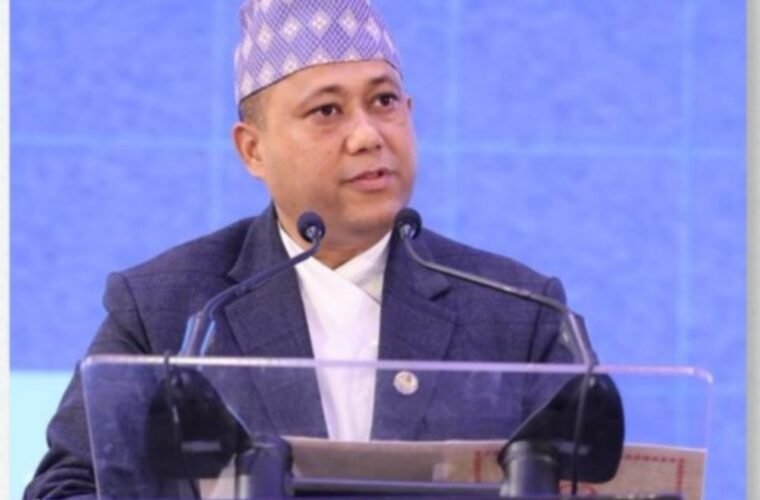
Foreign Minister Shisir Khanal is set to embark on an official visit to Beijing on Sunday, at a time of growing significance for Nepal’s foreign policy and regional diplomacy. His four-day sojourn in China is expected to draw considerable attention in political and diplomatic circles as Kathmandu navigates an increasingly complex regional environment while seeking to advance its development priorities.
The bilateral talks between Chinese Foreign Minister Wang Yi, a seasoned diplomat with long experience in Nepal-related affairs, and Khanal, a relatively new figure on Nepal’s national political stage, are expected to cover a wide range of strategic, economic and developmental issues shaping Nepal-China relations.
he visit comes within a broader context of steadily deepening China–Nepal engagement. The Chinese side has consistently emphasized that since the establishment of diplomatic relations between China and Nepal in 1955, the two countries have “shared weal and woe and forged through hardships together,” co-writing a long history of good-neighbourliness and enduring friendship. The relationship was further elevated in 2019 during President Xi Jinping’s historic state visit to Nepal, when bilateral ties were upgraded to a Strategic Partnership of Cooperation featuring ever-lasting Friendship for Development and Prosperity, marking the beginning of a new phase in China–Nepal engagement.
Under this framework, political mutual trust has continued to deepen. The two sides have signed the Framework for Belt and Road Cooperation and expanded collaboration across connectivity, infrastructure, agriculture, energy, environmental protection, education, health, law enforcement and emerging technologies, yielding tangible benefits for both peoples. With 2026 marking the opening year of China’s 15th Five-Year Plan, Beijing has signaled its intention to pursue higher-level opening up and high-quality development, offering new opportunities for countries including Nepal. It has also expressed readiness to further align development strategies, expand pragmatic cooperation and advance the building of a closer China–Nepal community with a shared future.
The visit of the Nepali foreign minister therefore comes within this broader diplomatic and developmental framework, offering both sides an opportunity to translate long-standing political understanding into practical cooperation outcomes.
The visit also comes against the backdrop of significant political change in Nepal. Following its decisive victory in the March 2025 elections, the Rastriya Swatantra Party (RSP), a relatively young political force, formed the government and is currently in the early phase of its tenure. The Beijing visit provides an opportunity for the new administration to articulate its foreign policy priorities and strengthen engagement with one of Nepal’s most important diplomatic and development partners.
As with Khanal’s recent visit to India, the Beijing visit is expected to generate discussion on Nepal’s efforts to maintain balanced and constructive relations with its two immediate neighbours. Several issues are likely to feature prominently in the discussions.
Among them is the question of border-related matters, including the tri-junction point involving Nepal, China and India. The issue has drawn attention in recent years. Another key area is the implementation of projects under the Belt and Road Initiative (BRI) Framework Agreement signed between Nepal and China last year. While ten projects have been proposed, questions remain regarding their feasibility, financing structures and implementation progress.
Discussions are also expected to focus on Nepal’s longstanding commitment to the One-China principle, China’s security concerns and mechanisms for strengthening mutual trust. One of Khanal’s key objectives will likely be to reassure the Chinese leadership of Nepal’s continued adherence to principles that have guided bilateral relations for decades, including the commitment that Nepali territory will not be used for activities detrimental to China’s security interests.
Beyond strategic considerations, however, the visit presents a significant opportunity to deepen practical cooperation in areas directly linked to Nepal’s development priorities.
Nepal and China share a relationship founded on mutual respect, sovereign equality and peaceful coexistence. Over time, cooperation has expanded beyond diplomacy into infrastructure, trade, investment, education, tourism, agriculture and people-to-people exchanges.
Agriculture remains one of the most promising sectors for deeper collaboration, given its importance to Nepal’s rural economy. Challenges such as productivity, irrigation, storage, climate resilience and technology adoption remain pressing, while China’s experience in agricultural modernization offers potential avenues for cooperation in research, technology transfer and capacity building.
Similarly, economic cooperation continues to be a key pillar of bilateral relations. China’s technological capability, industrial strength and investment capacity can contribute significantly to Nepal’s aspirations for job creation, industrial development and economic diversification. Chinese investment in productive sectors, if aligned with Nepal’s priorities, can help strengthen industrial capacity, create employment opportunities and support the country’s long-term development ambitions.
Infrastructure development has already become a defining feature of bilateral cooperation, particularly in energy, transport and connectivity sectors. Continued collaboration in these areas is expected to support Nepal’s long-term development goals and improve living standards. Greater connectivity and more efficient cross-border economic linkages could also contribute to expanding trade and people-to-people exchanges between the two countries.
At a time when international relations are often viewed through a geopolitical prism, Nepal and China have an opportunity to demonstrate that genuine partnership is best measured by its contribution to development, prosperity and the well-being of ordinary people. Such an approach would help ensure that bilateral cooperation remains grounded not merely in strategic calculations but in tangible benefits for citizens of both countries.
The economic dimension of the visit is therefore likely to be as important as its diplomatic significance. Nepal is seeking greater foreign investment, technology transfer, and market access and infrastructure development to support its long-term economic transformation. The investment promotion activities and interactions with the Chinese business community scheduled during the visit underscore the growing importance of economic diplomacy in Nepal’s external engagement. Converting political goodwill into concrete economic outcomes will remain one of the key tests of the visit’s success.
Former Nepali Ambassador to China Rajeshwor Acharya also underlines the importance of the visit, stating that Foreign Minister Khanal’s China trip could help create an atmosphere of trust and take bilateral relations to a new height. He emphasizes that just as Nepal has consistently supported China’s territorial integrity and indivisibility, Beijing should also respect Nepal’s sensitivities and positions. He further notes that issues such as Lipulekh should not be overlooked in the broader context of regional understanding and mutual respect.
Former Foreign Minister Prakash Sharan Mahat, meanwhile, views such high-level exchanges as an important instrument for strengthening bilateral relations. In his view, Minister Khanal’s visit should focus on issues of mutual interest and practical cooperation, while ensuring that the promotion of Nepal’s national interest remains paramount. His observation reflects a longstanding principle of Nepali diplomacy—that engagement with neighbours should be guided by both mutual benefit and the pursuit of national priorities.
The visit also offers an opportunity for the new government in Kathmandu to establish a clearer understanding with Beijing regarding its foreign-policy priorities. As a relatively new administration, the government has an interest in reassuring partners that Nepal’s external relations will continue to be guided by consistency, predictability and respect for long-standing commitments. For China, the visit provides an opportunity to better understand the priorities and expectations of Nepal’s new political leadership.
Ultimately, the success of Nepal-China relations should not be measured only by high-level visits, agreements or diplomatic symbolism, but by the tangible improvements they bring to people’s lives—including better infrastructure, expanded employment opportunities, stronger agricultural productivity, enhanced connectivity and sustained economic growth. These are the outcomes that matter most to ordinary citizens.
Foreign Minister Shishir Khanal’s visit to China therefore represents more than a routine diplomatic engagement. It offers an opportunity to define the next chapter of Nepal–China relations—balancing strategic trust with development cooperation, diplomatic understanding with practical partnership, and regional realities with the aspirations of ordinary citizens. If both sides continue to prioritize practical cooperation, mutual benefit and people-centered development, the partnership can contribute significantly to Nepal’s socio-economic progress while further strengthening the longstanding friendship between the two neighbouring countries.
As Nepal seeks to navigate an increasingly competitive geopolitical environment, maintaining constructive relations with both its neighbours while steadfastly safeguarding national interests will remain a central challenge of its foreign policy. The Beijing visit provides an opportunity not only to strengthen bilateral ties, but also to reaffirm Nepal’s enduring commitment to an independent, balanced and development-oriented diplomacy.