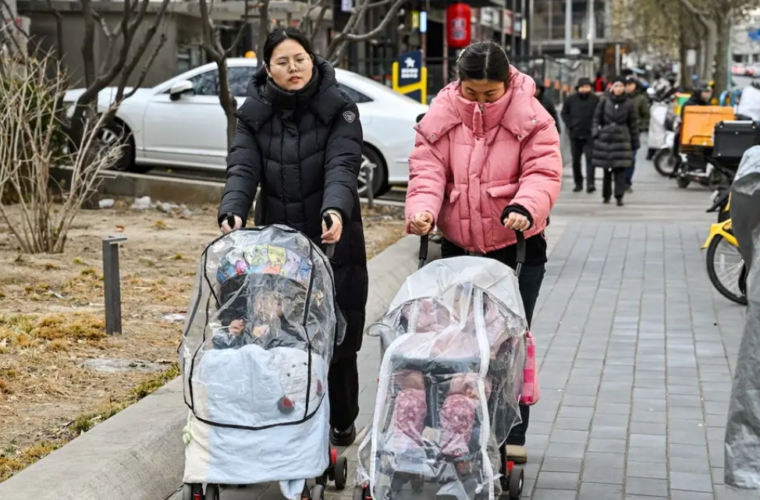
China is experiencing a rapid demographic shift marked by an ageing population and declining fertility, with the demographic advantage that supported decades of economic expansion now increasingly turning into a liability, according to a Taiwanese researcher cited in a report by the Taipei Times.
In an article titled “Observations on China’s Population Structure Issues,” published in the Mainland Affairs Council’s latest briefing on Mainland China and Cross-Strait Situation, Wang Chan-hsi, an associate researcher at the Institute for National Defence and Security Research, noted that China’s birthrate has dropped significantly since 2016.
He pointed out that the number of newborns fell to 7.92 million last year, just 44 per cent of the 2016 figure.
This decline not only fell below earlier projections of 9 million and 8 million births but also marked the lowest level since the founding of the People’s Republic of China in 1949. He added that China’s total population has decreased to 1.40489 billion, registering four straight years of negative growth.
Wang warned that China’s birthrate is falling rapidly and could reach levels similar to those seen in Taiwan, Japan, and South Korea within the next three to five years. As births decline, the education sector has already begun to feel the impact.
Around 20,000 kindergartens were shut down in 2024, leading to the loss of more than 240,000 preschool teaching jobs, according to the report.
Primary schools are also witnessing a yearly drop of over 2 million students since 2023, with many regions experiencing a sharp reduction in teaching positions. Educators are increasingly being pressured to shift roles, further contributing to unemployment linked to the falling birthrate.
The population’s gender structure is also showing imbalances, with a higher number of men in rural areas and more women in urban centres. Data from China’s 2021 Seventh National Census indicates a gender ratio of 106 males per 100 females in cities, rising to 120 males per 100 females in rural areas.
Wang noted that nearly 30 million unmarried young men live in rural China, while more than 20 million unmarried women reside in first- and second-tier cities, a disparity that continues to depress marriage and birth rates.
He further highlighted that China’s ageing population, combined with the challenge of “growing old before getting rich” and weak consumer demand, could lead to significant economic and social consequences. Although the pace of ageing is approaching that of other East Asian countries, China’s overall wealth levels remain comparatively low.
In addition, income distribution among the elderly is highly uneven. Of the more than 320 million retirees, around 180 million rural pensioners receive less than 200 RMB per month, while only about 17 million urban retirees earn over 5,000 RMB monthly, accounting for just 5.3 per cent of the retired population.
Over the medium to long term, Wang cautioned that declining fertility and rapid ageing are likely to pose serious challenges to sustainable development, with the potential to disrupt China’s economic and social systems more severely than previously expected.