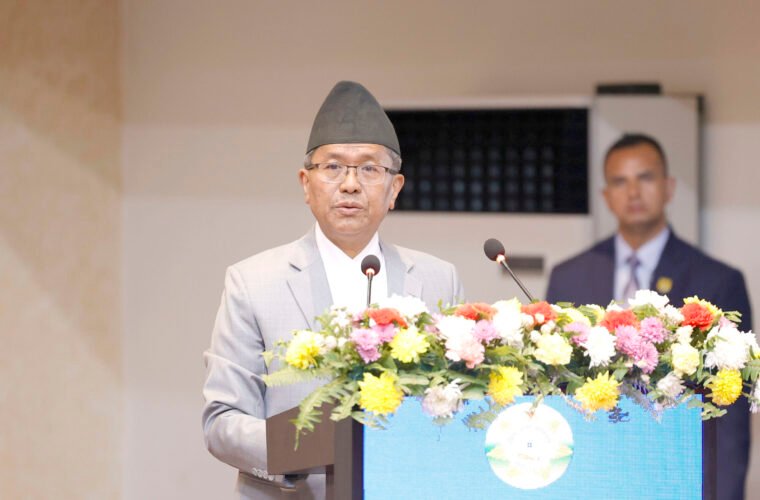
Kathmandu, Feb 11: Chief Commissioner of the Commission for the Investigation of Abuse of Authority (CIAA), Prem Kumar Rai, has expressed concern over the increasing influence of middlemen in the country’s governance and administration.
Addressing a programme marking the 35th establishment day of the CIAA here today, he said that over the past few years, citizens have perceived that powerful intermediaries have started becoming active in various matters, ranging from small administrative tasks to budget formulation, project selection, high-level appointments, ministerial selection and even government changes.
He stated that the tendency of intermediaries coming into play in every task has been undermining the autonomy and good governance of the state mechanism.
“In the past, intermediaries used to work in government offices that provided frontline services for small facilitation tasks, but in the last five to 10 years, there is a common understanding that the influence of powerful intermediaries has been increasing in matters such as budget formulation, planning, appointments in key bodies, transfers, promotions, ministerial appointments, and even government changes,” said Chief Commissioner Rai.
Stating that public complaints have been received that good governance has not been established in the State because these intermediaries have started to take control of the government and all its bodies and act at their discretion, Chief Commissioner Rai said if the state bodies cannot prohibit intermediaries in all areas, good governance appears to be limited to slogans only.
He emphasized that the CIAA has continuously pursued objective investigation of corruption-related offences and prosecution in the Special Court as per its constitutional responsibility, stating that focus has now been given to preventive and promotional strategies.
Similarly, Chief Commissioner Rai added that according to the latest amendment of the Anti-Money Laundering Act, 2064, the Commission is responsible for investigating offences related to laundering of properties acquired from corruption-related crimes, and the Commission has been carrying out the investigation and prosecution of such offences as well.
He stated that the CIAA has been formulating its strategic plan to control corruption and promote good governance, and in addition to corrective actions, it has also been undertaking preventive and promotional measures.
Rai mentioned that the Commission has implemented the Fifth Strategic Plan (2081/82–2085/86) with a vision of ‘building a corruption-free and accountable public sector’ and that it aims to reduce corruption through remedial, preventive, and promotional approach.
He claimed that investigations and prosecution have been made effective by prioritising high-risk areas at present.
Chief Commissioner Rai also stated that the quality of the CIAA’s investigation has been enhanced through the improvement of the complaint management system, expert consultation, advocacy by private legal practitioners, expansion of information technology use, innovative investigation methods, and the specialised capacity development of investigation officers.
It is stated that in the past five years, 148 thousand 500 complaints have been registered with the Commission. Of these, 107 thousand 915, or 72.8 percent, have been settled.
During that period, the CIAA has filed more than 700 corruption-related cases in the Special Court. One hundred and thirty-seven cases were filed in the fiscal year 2081/82, and so far 94 cases have been filed in the current fiscal year.
The Commission has stated that claims worth more than four billion rupees on average annually have been lodged over the past five years for compensation of losses incurred to the state treasury.
Highlighting the increasing public trust in the Commission, Chief Commissioner Rai claimed that prosecutions are being conducted fearlessly against officials of any political or administrative level based on evidence.
Cases are also being filed by the Commission related to offences concerning money laundering, he added.
He stated that the action plan to expand the necessary corrective actions to get Nepal out of the Financial Task Force’s ‘grey list’ is also being implemented.
Chief Commissioner Rai pointed out that although the number of complaints at the Commission is increasing, there is a lack of factual and plausible complaints.
He stated that there is a problem of delayed investigation due to not receiving evidence and documents from the concerned authority on time and in full during the investigation.
According to the CIAA, complaints regarding public procurement and construction, budget allocation, grant distribution, taking of illegal benefits causing loss to state coffers, damage to public property, bribery, fake educational certificates, revenue leakage and illegal acquisition of property are higher.
Rai stated that only projects that have completed the legal process in the Project Bank should be entered, and all three levels of government should be serious about budget allocations based on that.
He also said that serious irregularities are increasing, such as procurement without a procurement plan, limiting competition, direct procurement, large investments in medical equipment and information technology materials without infrastructure, constructing structures without an operating plan, and stockpiling unused materials.
Likewise, Chief Commissioner Rai stated that due to extensions in contract management, lack of guidance and weak record-keeping, the state suffered significant losses in claims for compensation, and that the responsible officials should be held legally accountable.
He further said that the Commission had given 428 suggestions to 12 different sectors and 24 ministries/agencies, but the implementation of these suggestions has not been satisfactory and similar mistakes are being repeated.
“There have been public comments by responsible officials that the commission’s suggestions have hindered development, construction, and budget implementation. However, these suggestions are given to remind of legal provisions to correct shortcomings during performance and they do not hinder development; rather, they can help maintain good governance and make development more results-oriented,” the CIAA Chief Commissioner argued.