Reuters: The ICE officer involved in the fatal shooting of a 37-year-old mother in Minneapolis fired the first of three shots as the car moved past him, a Reuters analysis of the available visuals shows.
The final moments in the life of Renee Nicole Good, a U.S. citizen and mother of three, have been relentlessly dissected since she was shot dead in her maroon-colored SUV during immigration enforcement actions in a residential neighborhood of Minneapolis on Wednesday.
President Donald Trump wrote in a Truth Social post that Good “ran over the ICE Officer, who seems to have shot her in self-defense.” Minneapolis Mayor Jacob Frey in a press conference Wednesday rejected the Trump administration’s assertion and said that having watched the video of the shooting, he believed claims of self-defense are “bullshit.”
The Reuters analysis is based on videos from onlookers that were independently verified by the news agency. None of the videos shows the moving vehicle from the officer’s perspective.
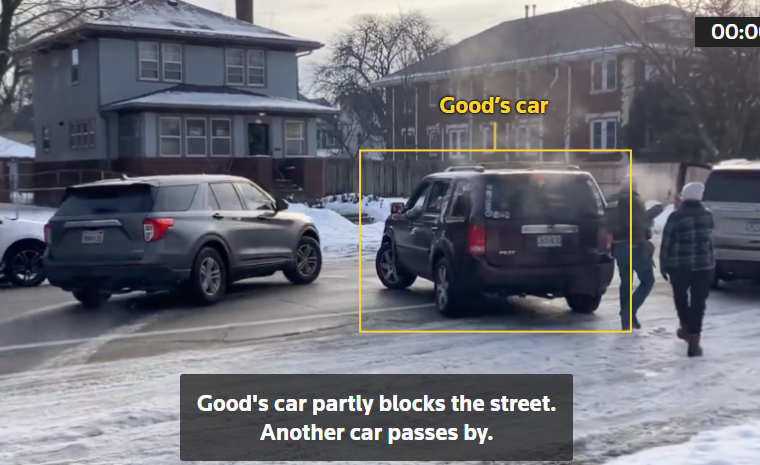
The videos reviewed by Reuters cover 20 seconds in the deadly encounter between Good and ICE. They show the ICE officer who fired the fatal shots was standing in front of the moving vehicle when he initially drew his firearm.
He opened fire one second later, firing three shots. The first pierced the windshield of Good’s car as the vehicle moved past him. The second and third shots were fired into the driver’s side of the vehicle as it continued moving past him.
Asked for comment on Reuters’ findings, the Department of Homeland Security spokeswoman Tricia McLaughlin called Good a violent rioter who weaponized her vehicle in an act of “domestic terrorism.”
Two experts consulted by Reuters said the actions of the officer would need further review.
Geoffrey Alpert, a professor of criminology and criminal justice at the University of South Carolina, questioned why the ICE agent would place himself in front of a moving car.
Alpert said the officer’s positioning could be an example of officer-created jeopardy. “The crux of officer-created jeopardy is putting yourself in a position to use force in response to whatever the suspect’s doing, as opposed to just reacting to protect his own life or someone else’s,” said Alpert.
Ashley Heiberger, a police use-of-force expert with more than two decades of law enforcement experience in Pennsylvania, said that he could not draw a firm conclusion on the incident without a detailed analysis.
He said that the use of force for a non-violent crime needed to be proportionate.
But he cautioned that the fact that the officer fired the second and third shots through the driver’s side window did not automatically mean it was an inappropriate use of force. The officer’s mind has to perceive the threat is over and then tell the body to stop shooting, Heiberger said. “It doesn’t happen simultaneously.”