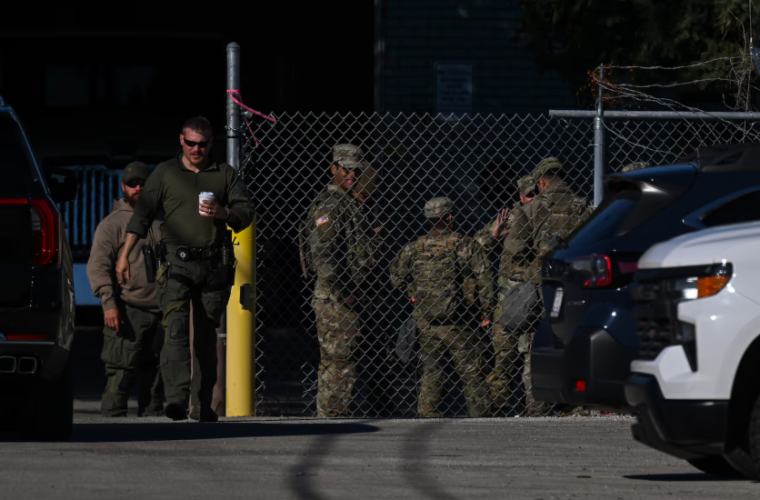
The Supreme Court said Tuesday it would not allow President Donald Trump to deploy the National Guard in the Chicago area for now, a significant setback for his campaign to push troops into cities across the country over the objections of local and state leaders.
The president’s ability to federalize the National Guard likely only applies in “exceptional” circumstances, the court’s unsigned order said.
Justices Samuel Alito, Clarence Thomas and Neil M. Gorsuch dissented from the court’s unsigned order. Justice Brett M. Kavanaugh filed a separate concurrence.
The Chicago case is the first time the Supreme Court has weighed in on one of Trump’s attempted deployments of National Guard forces. While temporary, the order could have far-reaching effects by repudiating Trump’s claim of virtually unchecked authority to mobilize and deploy troops he says are necessary to fight crime and protect immigration enforcement officers.
The order could affect how lower courts rule in other cases where local and state officials have sued to block Trump’s deployments, such as in Portland, Oregon. It may have less immediate effect on the National Guard deployment in D.C. because of the federal government’s unique role in overseeing the nation’s capital.
It also stands out as a rare example of the Supreme Court blocking the administration’s efforts to move forward with policies that lower courts have temporarily halted.
The high court, which is dominated by a 6-3 conservative majority, has repeatedly approved of Trump’s actions this year, allowing his administration to freeze billions in foreign aid, gut the Education Department, fire senior officials of nominally independent agencies and strip temporary protections from hundreds of thousands of Venezuelan immigrants.
The case came to the Supreme Court after lower courts blocked Trump’s deployment of National Guard forces to the Chicago area. The administration asked the high court to put the lower court ruling on hold. Although the administration told the court that the situation was an emergency, requiring swift action, the justices took weeks to consider it.